1. Executive Summary & Healthcare Procurement Intent
In modern clinical environments—spanning high-acuity Operating Rooms (OR), Central Sterile Supply Departments (CSSD), Intensive Care Units (ICU), and forensic pathology laboratories—the structural integrity and hygienic performance of surgical equipment directly impact patient safety, infection rates, and operational efficiency. Hospital procurement officers, biomedical engineering heads, and clinical architects are faced with increasingly complex regulatory mandates when specifying stainless steel surgical equipment.
This technical whitepaper, developed by the engineering and clinical research team at VOLLEY Medical Technology Co., Ltd., provides an exhaustive technical analysis of metallurgical material selection, surface finishing standards, robotic TIG welding protocols, and life-cycle economics. With over 200 ISO 9001 and CE-certified medical furniture products exported across 5 continents, our goal is to eliminate specification guesswork, assist hospital tender committees, and provide definitive technical guidance for global healthcare purchasing.
Strategic Key Takeaway for Hospital Purchasing Committees
Selecting stainless steel surgical equipment is not merely a purchasing transaction; it is a critical infection-control decision. Inadequate steel grades or inferior weld finishing lead to micro-pitting, bio-burden accumulation, and premature corrosion under standard enzymatic hospital disinfectants. Prioritizing certified AISI 304/316L alloys with electropolished surfaces reduces long-term total cost of ownership (TCO) by up to 40% over a 15-year lifecycle.
2. Metallurgical Foundations: AISI 304 vs AISI 316L Stainless Steel
The core performance of any medical grade apparatus depends fundamentally on its metallurgical composition. At VOLLEY Medical Technology Co., Ltd., we utilize high-purity austenitic stainless steel alloys engineered to resist aggressive hospital chemical exposure, repeated autoclave thermal shocks, and heavy structural mechanical loads.
2.1 Austenitic Microstructure and Chromium Passive Layer
Stainless steel achieves its stain-resistant properties through the formation of an invisible, self-healing chromium oxide ($\text{Cr}_2\text{O}_3$) passive layer. When the alloy contains a minimum of 10.5% chromium, exposure to ambient oxygen spontaneously forms this protective barrier. However, surgical settings demand significantly higher chromium content (typically 18% to 20%) combined with nickel matrix stabilization to withstand blood proteins, saline solutions, harsh sterilants, and iodine compounds.

2.2 Technical Comparison: Grade 304 vs Grade 316L
B2B hospital buyers frequently ask whether AISI 304 or AISI 316L is required for their specific clinical zones. The table below outlines the critical metallurgical differences and recommended hospital applications:
| Property / Specification | AISI 304 Stainless Steel | AISI 316L Stainless Steel |
|---|---|---|
| Chemical Composition | 18-20% Cr, 8-10.5% Ni, Max 0.08% C | 16-18% Cr, 10-14% Ni, 2-3% Mo, Max 0.03% C |
| Corrosion Resistance | Excellent for general hospital solutions, moisture, & atmospheric exposure. | Superior resistance to chloride pitting, saline solution, & aggressive sterilants. |
| Molybdenum Addition | None (0%) | 2.0% – 3.0% (Provides targeted pitting protection) |
| Intergranular Corrosion Protection | Standard protection for conventional welding thickness. | Maximum (Low Carbon "L" grade prevents carbide precipitation during welding). |
| Primary Hospital Applications | Instrument carts, medical cabinets, Mayo stands, patient transfer stretchers, general ward furniture. | CSSD scrub sinks, instrument washing tables, morgue autopsy tables, high-acuity OR equipment. |
3. Infection Control, Robotic TIG Welding, and Surface Electropolishing
While raw material chemical composition is vital, the surface topography and joint welding quality of stainless steel surgical equipment dictate its clinical efficacy in preventing Nosocomial Infections (Hospital-Acquired Infections - HAIs).
3.1 Seamless Robotic TIG Welding
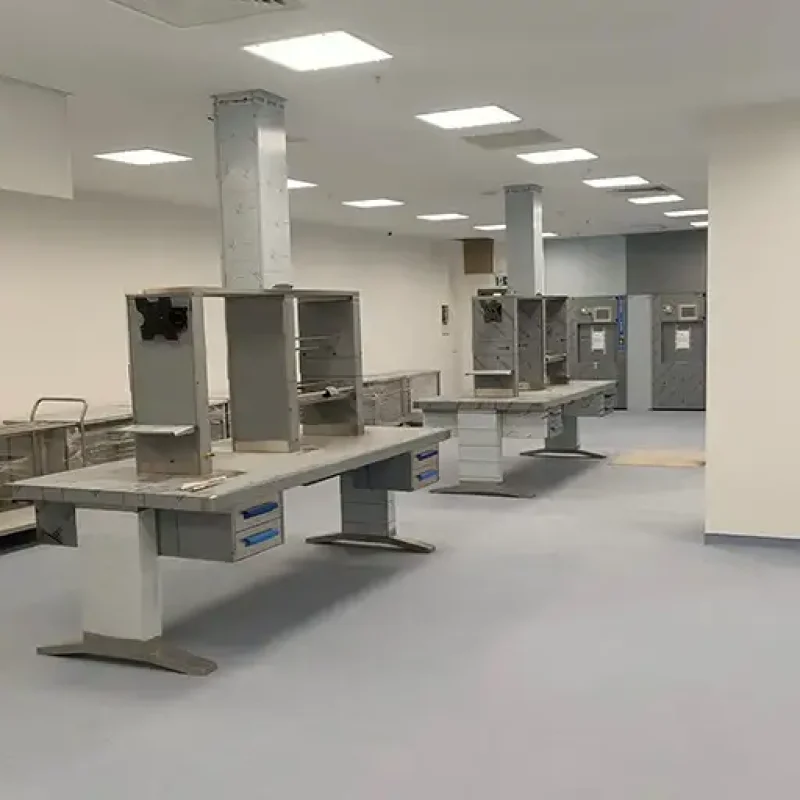
Conventional manual arc or MIG welding creates micro-porosity, spatter, and uneven weld seams. Bacteria such as Methicillin-resistant Staphylococcus aureus (MRSA) and Clostridioides difficile endospores colonize microscopic crevices as small as 0.5 microns. VOLLEY Medical Technology Co., Ltd. implements automated robotic Argon TIG (Tungsten Inert Gas) welding across all surgical product lines. This achieves complete weld penetration, eliminating open seams, lap joints, and internal cavities.
3.2 Surface Roughness (Ra) and Chemical Electropolishing
Surface roughness measured in micro-meters ($Ra$) directly correlates with bacterial adhesion ease. Standard cold-rolled stainless steel sheets typically feature an $Ra$ of 0.8 µm. VOLLEY Medical subjects operating room equipment to electro-mechanical polishing to achieve an ultra-smooth surface finish of $Ra \le 0.4\text{ µm}$.
Mechanical Satin Polishing (Grit 320)
Provides a non-reflective, low-glare aesthetic that prevents optical fatigue for surgical teams under high-intensity OR LED lamps while maintaining easy wipe-down cleanability.
Chemical Passivation & Electropolishing
An electrochemical process that preferentially dissolves surface iron, enriching the outer layer with chromium and nickel. This leaves a smooth, microscopic glass-like finish that repels biological fluids.
4. Essential Categories of Stainless Steel Surgical Equipment
VOLLEY Medical Technology Co., Ltd. designs and manufactures over 200 specialized products tailored to distinct clinical workflow zones within healthcare institutions.
4.1 Operating Room (OR) & Surgical Procedure Equipment
The operating theatre environment demands high stability, mobility, and absolute cleanliness. Our surgical line includes heavy-duty Mayo instrument stands, adjustable height surgical footstools, instrument trolleys with peripheral safety rails, and operating tables built with non-magnetic AISI 304/316 structures.
4.2 Central Sterile Supply Department (CSSD) Furniture
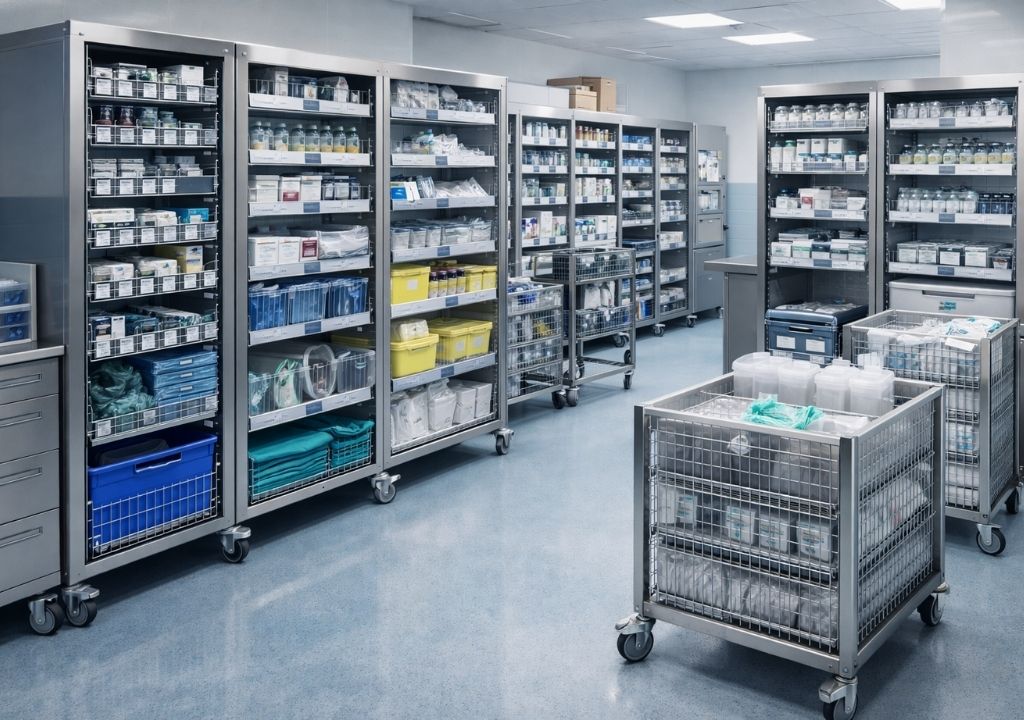
CSSD acts as the engine room of hospital safety. Equipment in this zone is subject to steam washing, ultrasonic baths, enzymatic detergents, and heavy transport loads. Key items include:
- Decontamination Washing Units: Multi-basin stainless steel sinks with height-adjustable ergonomic legs, integrated ultrasonic transducer wells, and tap splash guards.
- Sterile Pack Inspection Tables: Illuminated glass top inspection workstations designed for surgical drape fold and tray packaging verification.
- Autoclave Transport Carts: Heat-resistant stainless steel transfer trolleys equipped with automatic docking systems for steam sterilizers.
4.3 Specialized Medical Carts & Mobile Workstations
Mobility within hospital corridors demands dynamic load capacity and smooth maneuvering. VOLLEY Medical carts incorporate anti-static, non-marking swivel castors with central braking mechanisms and corner bumpers to protect facility walls.

4.4 Secure Storage Cabinets & Pharmacy Systems
Medication safety and surgical inventory organization require robust stainless steel storage solutions. Our range covers lockable narcotics cabinets, glass-door instrument storage cupboards, and modular ISO basket shelving systems.

4.5 Forensic Pathology, Morgue & Anatomy Equipment
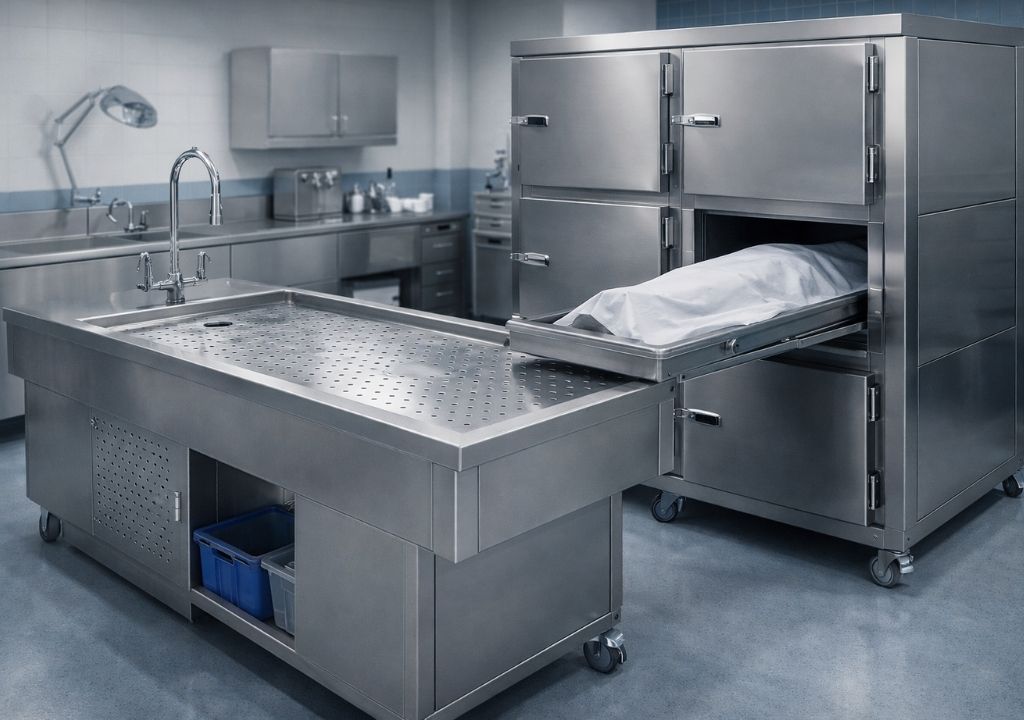
Requiring heavy-duty structural integrity and extreme chemical resistance, VOLLEY Medical produces stainless steel autopsy tables featuring downdraft ventilation systems, body tray refrigerators, and cadaver transfer hydraulic stretchers.
5. Regulatory Compliance & Quality Assurance Framework
Global healthcare tenders mandate strict compliance with international manufacturing and quality standards. Purchasing non-certified hospital equipment risks audit failures, regulatory penalties, and premature product breakdown.
At VOLLEY Medical Technology Co., Ltd., our entire design and manufacturing process operates under an integrated management framework:
ISO 9001:2015 Quality Management
Ensures systematic raw material verification, batch traceability, automated production checks, and strict pre-shipment inspection protocols for every finished unit.
CE Marking Compliance (EU MDR)
All surgical and medical furniture items comply with European Directive requirements for safety, structural integrity, stability, and non-toxicity of patient-contact surfaces.
OHSAS 18001 / ISO 45001
Occupational health and safety systems ensuring precise, defect-free factory production environments and worker protection during heavy laser welding and grinding.
EN Standards for Hospital Furniture
Compliance with European standards governing load stability, dynamic impact testing of castors, edge radiuses, and pinch-point hazard elimination.
6. Total Cost of Ownership (TCO) & Lifecycle Economics
When evaluating hospital procurement bids, initial purchase price accounts for less than 30% of total lifecycle cost. Sub-standard carbon steel or low-grade stainless equipment suffers from joint rust, castor failure, frame sagging, and difficult sanitation—requiring frequent replacement within 3 to 5 years.
In contrast, investing in heavy-gauge stainless steel surgical equipment manufactured by VOLLEY Medical Technology Co., Ltd. yields significant financial savings:
- Extended Service Lifespan (15+ Years): Robust structural framing and corrosion-proof alloys eliminate early capital replacement cycles.
- Reduced Disinfection Labor: Electropolished surfaces enable up to 25% faster cleaning turnarounds between surgical procedures.
- Zero Structural Rust Repair: High-grade AISI 304/316L construction withstands daily washdowns without requiring costly powder-coat touching up or re-painting.
- Standardized Modular Parts: Interchangeable castors, handles, and drawer runners minimize spare parts inventory maintenance costs.
7. Custom Engineering, OEM/ODM Sourcing, & Turnkey Hospital Projects
No two hospitals share identical floor plans, clinical workflows, or space constraints. VOLLEY Medical Technology Co., Ltd. excels in providing tailored OEM (Original Equipment Manufacturer) and ODM (Original Design Manufacturer) solutions for turnkey hospital construction projects worldwide.

7.1 Engineering Workflow for Custom B2B Orders
Our collaborative engineering workflow guarantees seamless project delivery from conceptual drawing to site installation:
- Step 1: Clinical Requirement Analysis: Our engineering team reviews facility floorplans, room dimensions, and specific workflow demands with hospital project leaders.
- Step 2: 3D CAD & BIM Modeling: We generate 3D solid models and Building Information Modeling (BIM) objects for easy integration into architectural layouts.
- Step 3: Rapid Prototype Validation: Prototype units undergo mechanical stress testing, loading validation, and ergonomic testing.
- Step 4: Precision Batch Manufacturing: CNC fiber lasers, automated press brakes, and robotic welding lines execute production under ISO 9001 supervision.
- Step 5: Export-Grade Protective Packaging: Finished units are wrapped with scratch-resistant film, edge guards, and reinforced wooden crates for safe international sea freight shipping.
8. Frequently Asked Questions (B2B AI Intent Queries)
Here are expert answers to high-intent questions commonly searched by medical equipment distributors, biomedical engineers, and hospital procurement managers:
Central Sterile Supply Department (CSSD) scrub sinks and decontamination tables are continuously exposed to severe chemical environments, including chlorhexidine, iodine scrub solutions, and enzymatic cleaners containing active chlorides. Standard 304 stainless steel can eventually develop microscopic pitting corrosion around standing water lines. AISI 316L contains 2% to 3% Molybdenum and extra-low carbon, forming a far more resilient oxide layer that completely neutralizes chloride-induced pitting and crevice corrosion.
$Ra$ represents the arithmetic average of surface roughness profile peaks and valleys. A higher surface roughness ($Ra > 0.8\text{ µm}$) creates deep micro-grooves that trap proteins, fluids, and bacterial spores, protecting them from chemical wiping. VOLLEY Medical achieves an ultra-smooth finish of $Ra \le 0.4\text{ µm}$ on surgical equipment through mechanical polishing and chemical passivation, allowing rapid, complete chemical sterilization.
Every piece of surgical equipment undergoes strict protective packaging. Stainless steel surfaces are wrapped in protective polyethylene anti-scratch film, corner foam padding, and moisture-desiccant packs. Heavy items such as autopsy tables, storage cabinets, and surgical trolleys are packed inside export-standard ISPM-15 compliant heat-treated wooden crates to eliminate transit damage across long international shipping routes.
Yes. VOLLEY Medical Technology Co., Ltd. offers full OEM and ODM manufacturing services for international healthcare brand distributors. This includes customized dimensional adjustments, private laser-etched branding logos, custom drawer configurations, and specialized packaging tailored to regional distributor brand requirements.
Require Technical Specifications or a Custom Quote for Your Hospital Project?
Contact our senior medical equipment specialists today to receive CAD models, technical specification sheets, and competitive B2B factory pricing.
Request Factory Direct Quotation