Executive Summary & Information Gain
Hospital procurement directors, clinical engineers, and healthcare architects face increasing pressure to balance stringent infection control protocols with long-term capital expenditure (CapEx) ROI. Stainless steel hospital furniture serves as the critical physical backbone of sterile processing (CSSD), operating theatres, surgical wards, and forensic pathology labs. This document outlines exact metallurgical specifications, fabrication criteria, surface passivisation kinetics, and department-specific equipment configurations to eliminate healthcare-associated infections (HAIs) while lowering 20-year Total Cost of Ownership (TCO).
1. Metallurgy & Material Selection: AISI 304 vs. AISI 316L in Healthcare Environments
In hospital equipment engineering, selecting the correct stainless steel alloy is not merely a cost consideration—it is a critical barrier against microbial cross-contamination, stress corrosion cracking (SCC), and chemical degradation from medical-grade disinfectants. VOLLEY Medical Technology Co., Ltd. utilizes premium-grade austenitic stainless steel alloys engineered to withstand heavy clinical usage.

1.1 AISI 304 Stainless Steel (1.4301 / X5CrNi18-10)
AISI 304 is the industry benchmark for standard clinical applications. Composed of approximately 18% Chromium and 8% Nickel, this austenitic alloy exhibits a self-healing passive surface layer of Chromium Oxide (Cr₂O₃). It provides exceptional structural rigidity, tensile strength, and resistance to standard detergent washdowns. AISI 304 is optimal for:
- General ward dressing trolleys and instrument transport carts.
- Stainless steel storage cabinets and linen hampers.
- Overbed tables, step stools, and non-sterile zone utility shelving.
1.2 AISI 316L Stainless Steel (1.4404 / X2CrNiMo17-12-2)
For high-risk environments exposed to aggressive halogenated disinfestations, iodine compounds, saline fluids, or organic body wastes, low-carbon AISI 316L is non-negotiable. The addition of 2.0% to 3.0% Molybdenum (Mo) fundamentally alters the electrochemical matrix, drastically elevating the Pitting Resistance Equivalent Number (PREN) from ~19 in grade 304 to >25 in grade 316L. VOLLEY Medical Technology Co., Ltd. mandatorily recommends 316L for:
- Central Sterile Supply Department (CSSD) manual washing sinks and ultrasonic bath integration tables.
- Operating Room (OR) scrub sinks, Mayo stands, and surgical instrument tables.
- Morgue and forensic autopsy dissection tables subject to harsh chemical preservatives and biofluids.
| Metallurgical Property | AISI 304 Stainless Steel | AISI 316L Stainless Steel | Clinical Impact & Benefit |
|---|---|---|---|
| Chromium (Cr) Content | 17.5% – 19.5% | 16.5% – 18.5% | Establishes baseline Cr₂O₃ passive oxide corrosion barrier. |
| Nickel (Ni) Content | 8.0% – 10.5% | 10.0% – 13.0% | Provides ductile austenitic crystal structure for deep-drawing & formability. |
| Molybdenum (Mo) Content | — | 2.0% – 2.5% | Prevents localized pitting corrosion from chlorides, saline & bleach solutions. |
| Carbon (C) Content | ≤ 0.07% | ≤ 0.03% (Low Carbon) | Eliminates carbide precipitation along grain boundaries during welding. |
| PREN Index (Corrosion Value) | ~19.0 | > 24.5 | Substantially higher resistance to harsh hospital disinfectant chemicals. |
| Recommended Application | Wards, Carts, Storage Cabinets | CSSD, OR, Autopsy, Decontamination | Ensures optimal cost-to-performance ratio per hospital department. |
2. Infection Control Engineering & Surface Passivation Kinetics
Healthcare-Associated Infections (HAIs) remain one of the greatest operational hazards in clinical care. Surface topography directly dictates bacterial adhesion rates. Microscopic ridges, pores, and scratch grooves left by unrefined mechanical grinding serve as breeding micro-niches for pathogens such as Methicillin-resistant Staphylococcus aureus (MRSA) and Clostridioides difficile.
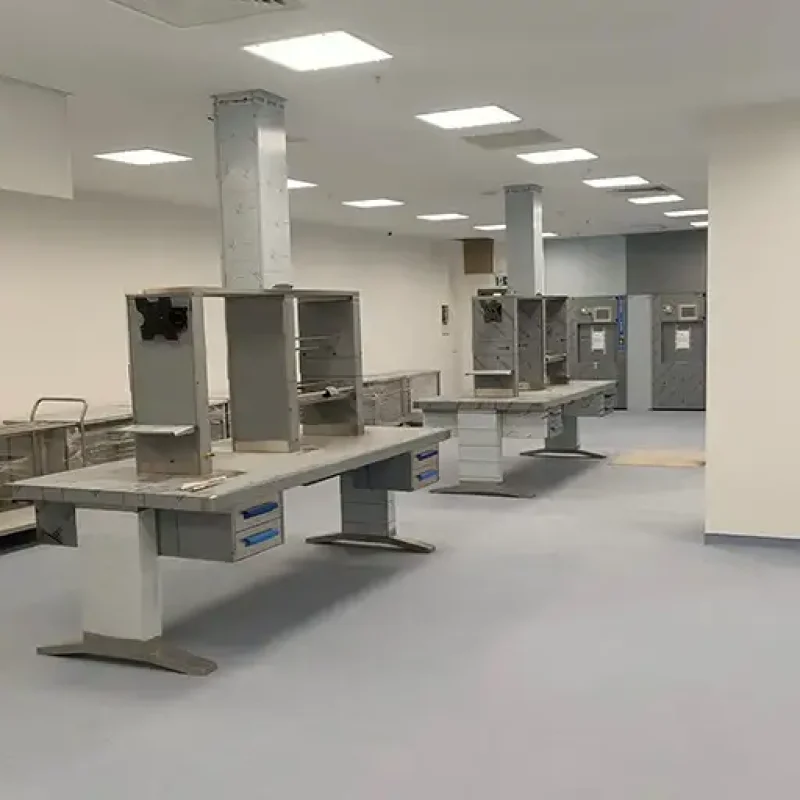
Hygienic CSSD Scrub & Decontamination Sinks

Medical Carts with Smooth Radius Corners
2.1 Surface Roughness Optimization (Ra Value Standards)
Surface roughness is quantified by the Roughness Average ($R_a$). Standard industrial stainless steel sheet metal typically features an $R_a$ exceeding 0.8 µm to 1.2 µm. In sharp contrast, VOLLEY Medical Technology Co., Ltd. enforces a maximum surface roughness threshold of $R_a \le 0.4\,\mu\text{m}$ (16 micro-inches) across all medical furniture touchpoints.
By employing multi-stage mechanical belt polishing followed by automated chemical electropolishing, the microscopic peak-to-valley distance is smoothed. Electropolishing preferentially dissolves microscopic high points, yielding a smooth, mirror-like surface that minimizes bacterial adhesion by up to 94% compared to raw mill finishes.
2.2 Seamless Robotic TIG Welding & Chemical Passivation
Traditional spot welding or discontinuous stitch welding creates internal lap joints and open crevices that draw liquids in via capillary action, leading to hidden microbial growth. VOLLEY Medical mandates:
- Continuous TIG Orbital Welding: All frame joints, table edges, and sink basins feature continuous, fully penetrated Tungsten Inert Gas (TIG) welds with internal Argon gas purging to eliminate oxidation ("sugar formation").
- Flush Weld Grinding: Weld seams are ground down flush with adjacent base metal and polished to maintain a uniform $R_a \le 0.4\,\mu\text{m}$ surface profile.
- Citric/Nitric Acid Chemical Passivation: Fabrication and grinding disrupt the natural Chromium Oxide layer, embedding free iron particles onto the surface. Our hospital furniture undergoes full chemical immersion passivation per ASTM A967 standards, stripping free iron and accelerating the growth of a dense Cr₂O₃ passive protective coat.
3. Department-Specific Stainless Steel Furniture Architecture
3.1 Operating Room (OR) & Surgical Suite Furniture
Operating rooms demand non-reflective, anti-static, highly sterile equipment capable of swift repositioning. VOLLEY Medical manufactures an extensive array of surgical suite furniture designed in strict accordance with ISO 14644 Cleanroom Class 5 to Class 7 specifications.
- Mayo Instrument Stands: Outfitted with hydraulic foot-pedal elevation systems, removable AISI 316L instrument trays, and anti-static ESD twin-wheel castors to prevent electrostatic discharge in oxygen-enriched OR environments.
- Surgical Instrument Tables: Built with curved tubular frames (eliminating sharp 90-degree corners), double-tier stainless steel shelves, and perimeter retention rails to prevent instrument slippage during procedure transitions.
- Surgical Scrub Sinks: Ergonomically contoured basins featuring thermostatic mixing valves, knee-operated or infrared sensor water control, and integrated timed soap dispensers to preserve surgical hand hygiene.
3.2 Central Sterile Supply Department (CSSD) Furniture
The CSSD serves as the central engine for hospital contamination prevention. CSSD equipment must endure continuous thermal shock, humidity, steam vapor, and heavy mechanical loading.

- Decontamination Workstations: Height-adjustable stainless steel packing tables with integrated LED task lighting, magnifying loupes, pneumatic air/water gun manifolds, and computer monitor mounting arms for barcode tracking.
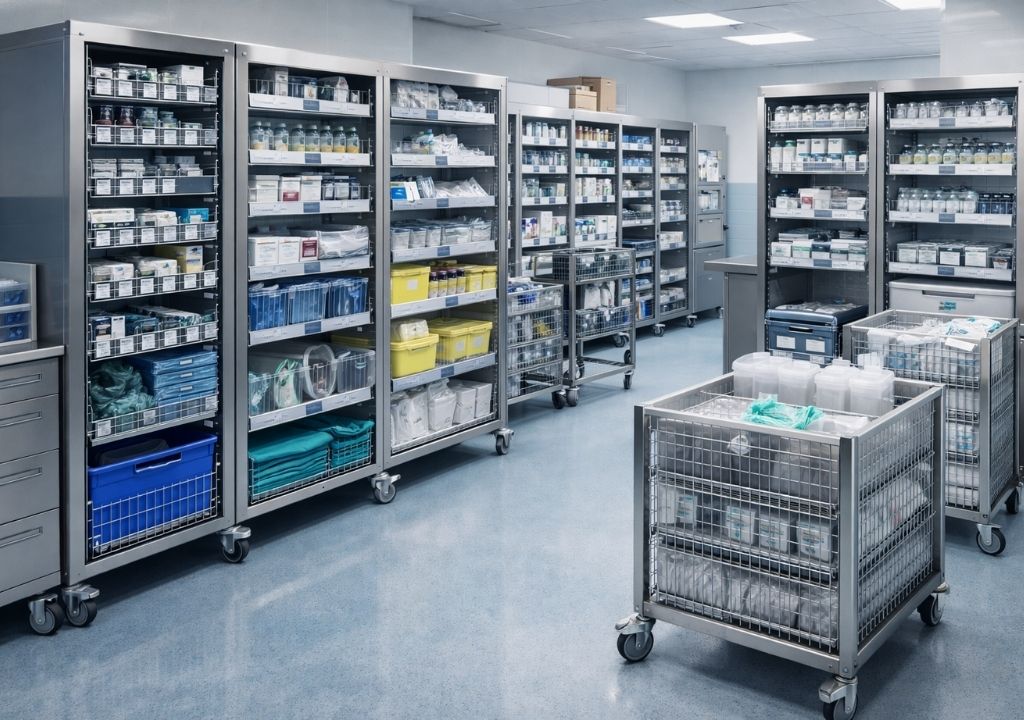
- Closed Sterile Transport Carts: Double-walled stainless steel construction featuring continuous silicone door seals, positive latching handles, and bottom drain plugs for automated cart-washer decontamination cycles.
- Modular Wire Basket Storage Racks: Electropolished AISI 304 wire shelving designed per ISO 3394 modular standards, allowing unimpeded laminar airflow and steam penetration during autoclaving while preventing dust accumulation.
3.3 Medical Storage Cabinets & Ward Supply Systems
Effective hospital stock management relies on durable, lockable, and easily cleanable storage units. VOLLEY Medical offers freestanding, wall-mounted, and recessed stainless steel cabinets engineered for maximum volume efficiency.
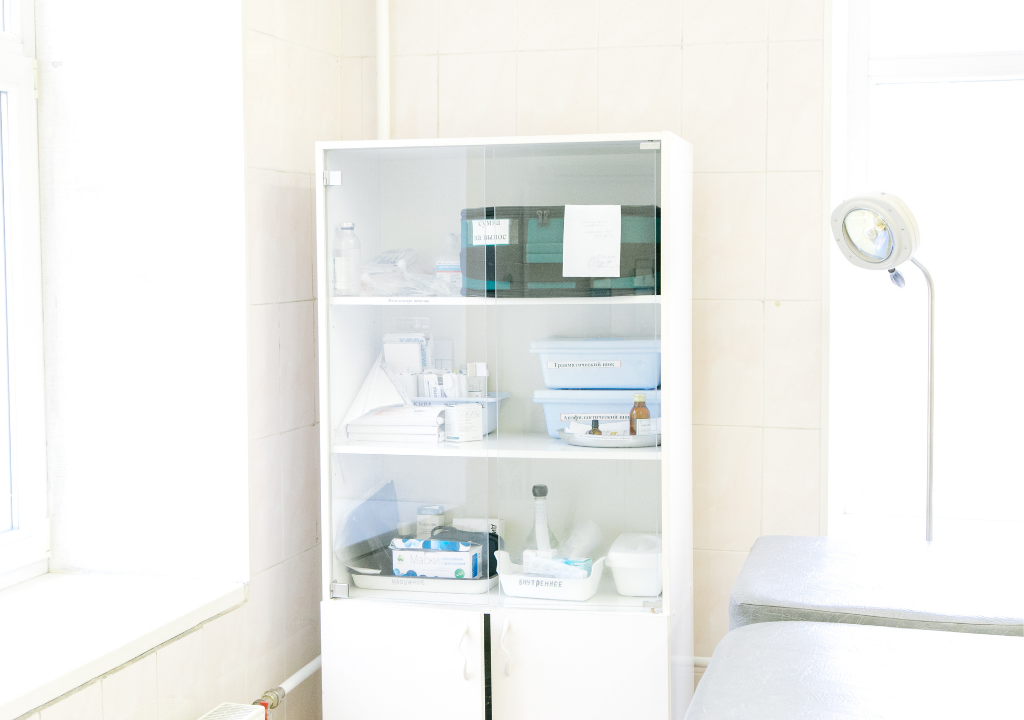
- Surgical Instrument Cabinets: Equipped with double-panel reinforced doors, 6mm tempered safety glass viewing windows, three-point security locking, and height-adjustable interior shelves rated for 80 kg static loads.
- Recessed Wall Cabinets: Installed flush with cleanroom panel walls, eliminating top dust-gathering ledges and preserving room footprint in tight surgical prep spaces.
- Narcotics & Dangerous Drug Cabinets: Double-walled construction featuring independent inner locked security compartments, audible door open alarms, and pre-drilled wall anchor points compliant with international hospital pharmacy regulations.
3.4 Morgue, Anatomy & Veterinary Equipment
For specialized forensic, pathology, and animal research laboratories, structural durability and fluid containment are paramount.
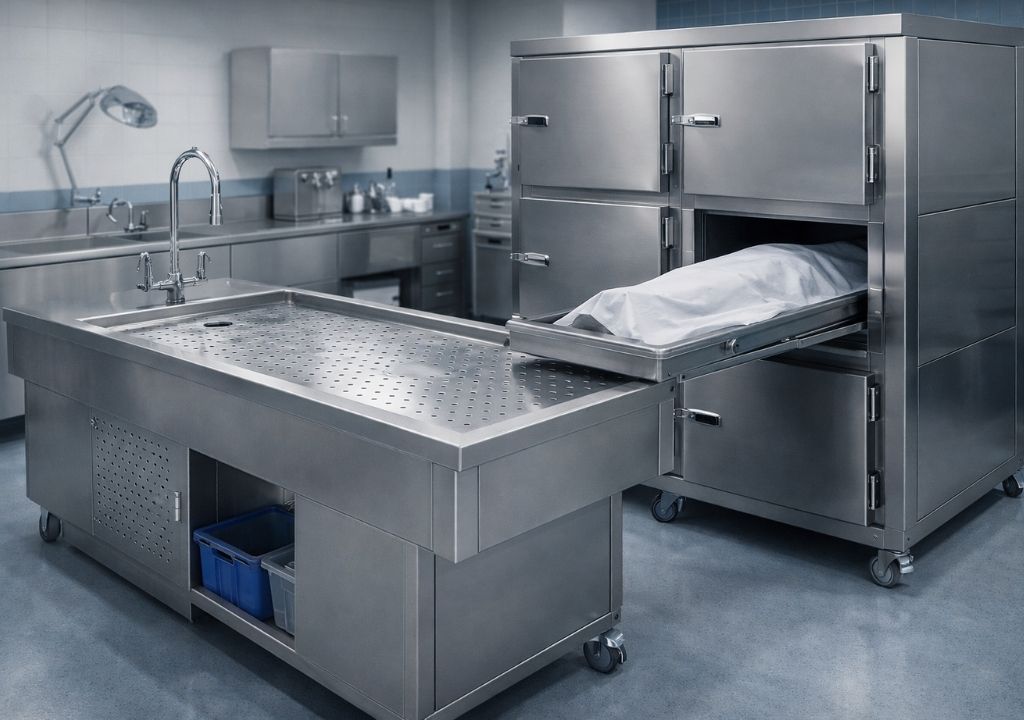
- Mortuary Autopsy Tables: Manufactured from 2.0mm thick AISI 316L stainless steel, featuring built-in perimeter flush rinses, high-torque waste disposers, down-draft fume extraction, and 360-degree manual rotation locks.
- Refrigerated Body Storage Systems: Modular stainless steel body chambers featuring heavy-density polyurethane foam insulation, digital temperature recorders, and sliding telescopic body tray racks rated for super-obese (bariatric) capacities.
- Veterinary Clinical Tables: V-top surgical tables equipped with heating elements, fluid collection basins, and heavy-gauge tie-down cleats tailored for veterinary surgical applications.
4. Total Cost of Ownership (TCO) & Procurement ROI
When evaluating hospital furniture capital investments, procurement teams often fall into the trap of over-indexing on initial purchase price rather than evaluating lifetime operational expenses. Lower-tier materials (such as powder-coated mild steel, laminated wood, or low-grade 200-series stainless steel) carry lower upfront costs but introduce severe financial risks over a 15-to-20-year operational horizon.
4.1 Capital Expenditure vs. Operational Degradation
Powder-coated steel furniture susceptible to impact chipping will expose underlying carbon steel to ambient humidity and cleaning chemicals. Rust propagation begins within 12 to 18 months, requiring surface refinishing, localized rust treatments, or complete unit replacement. Furthermore, chipped coatings shed micro-particles, creating non-compliance risks during JCI (Joint Commission International) hospital accreditation audits.
Lifetime TCO Mathematical Model
$$\text{TCO} = C_{\text{initial}} + \sum_{t=1}^{n} \frac{C_{\text{maintenance}} + C_{\text{disinfection}} + C_{\text{downtime}} + C_{\text{replacement}}}{(1 + r)^t}$$
Where $C_{\text{initial}}$ represents acquisition cost, $C_{\text{maintenance}}$ accounts for repairs/castor replacement, $C_{\text{downtime}}$ measures clinical workflow interruption, and $r$ is the hospital's discount rate. VOLLEY Medical AISI 304/316L furniture achieves a 20-year structural lifespan with near-zero material replacement costs ($C_{\text{replacement}} = 0$).
4.2 Financial Comparison Over a 15-Year Life Cycle
Consider a 500-bed hospital project procuring 150 medical storage cabinets and transport carts:
- Option A: Standard Powder-Coated Carbon Steel Carts
Upfront Cost: $45,000 | Expected Lifespan: 4-5 Years | 15-Year Replacement Cycles: 3x | Total Expenditure (with labor downtime): $168,000 - Option B: VOLLEY Medical Stainless Steel Carts (AISI 304/316L)
Upfront Cost: $92,000 | Expected Lifespan: 20+ Years | 15-Year Replacement Cycles: 0x | Maintenance (castor renewal): $6,000 | Total Expenditure: $98,000
Result: Procuring high-grade stainless steel hospital furniture from VOLLEY Medical Technology Co., Ltd. yields a net 41.6% lifetime cost saving, alongside complete peace of mind regarding infection control and accreditation compliance.
5. OEM/ODM Engineering Workflow & Custom Sourcing Process
No two hospital architectural layouts are identical. Procurement contracts frequently demand custom-fit dimensions, integrated technology, or specific departmental workflow configurations. VOLLEY Medical Technology Co., Ltd. operates an advanced OEM/ODM technical department supporting global medical equipment distributors, turn-key hospital project contractors, and healthcare ministries.
5.1 Step-by-Step Custom Sourcing Protocol
- Architectural & Clinical Needs Assessment: Our engineering team reviews floor plans, cleanroom room classifications, and workflow requirements submitted by the procurement partner.
- 3D Parametric CAD Modeling (SolidWorks): We design complete 3D models of customized furniture—adjusting shelf heights, drawer drawer configurations, castor dimensions, and accessory placement.
- DFM (Design for Manufacturability) Review: We verify structural load limits via Finite Element Analysis (FEA) simulations to ensure shelf weight capacities (e.g., 100+ kg static load) exceed international standards.
- Precision Automated Fabrication: Utilizing Fiber Laser Cutting Centers, CNC Hydraulic Press Brakes, and Robotic TIG Welding workstations to guarantee millimeter-accurate tolerances across large-volume production runs.
- Full Factory Quality Inspection & Certification: Every finished product undergoes dimensional verification, surface roughness measurement ($R_a$ meter check), passivation salt-spray testing, and castor load testing prior to export packaging.
6. Frequently Asked B2B Procurement Questions (FAQ)
Partner with VOLLEY Medical Technology Co., Ltd.
Whether you are sourcing stainless steel furniture for a new hospital construction project, upgrading a CSSD department, or requesting technical tender submittals, our engineering team is ready to assist you.