Executive Procurement Summary & Information Gain Overview
In modern acute healthcare facilities, hospital-acquired infections (HAIs), staff musculoskeletal injuries, and rapid patient deterioration during intra-hospital transfer represent major financial and clinical liabilities. Patient transport carts (also known as hospital patient transfer stretchers or clinical transfer trolleys) are not merely passive furniture; they are critical mobile transfer platforms bridging Emergency Departments (ED), Intensive Care Units (ICU), Operating Rooms (OR), and Central Sterile Supply Departments (CSSD).
This technical whitepaper, authored by the Engineering and Quality Assurance Directorate at VOLLEY Medical Technology Co., Ltd., provides hospital procurement committees, biomedical engineers, and facility architects with actionable, evidence-based criteria for specifying high-performance, heavy-duty patient transport carts engineered from premium AISI 304 stainless steel.
1. Macro Dynamics in Hospital Patient Transfer & Risk Mitigation
Intra-hospital patient transport occurs dozens of times daily in any medium-to-large healthcare institution. Whether transferring a trauma patient from an ambulance bay to radiology, moving a post-operative patient from OR to ICU, or shifting non-ambulatory patients between inpatient wards, the physical integrity and mechanical responsiveness of patient transport carts directly dictate clinical safety outcomes.
Recent studies in clinical logistics highlight three primary operational challenges that hospital procurement boards must evaluate during RFP (Request for Proposal) drafting:
- Prevention of Transfer-Induced Patient Trauma: Inadequate side-rail latching, structural chassis flex under heavy loads, or harsh deceleration caused by low-grade castors can exacerbate spinal injuries, compromise vascular access lines, or induce acute discomfort.
- Mitigation of Occupational Musculoskeletal Disorders (MSDs): Nurse and orderly push-pull fatigue accounts for over 35% of worker compensation claims in hospital logistics. Engineering transport carts with optimal push-bar geometry, lightweight structural frames, and directional caster locks significantly reduces initial push forces.
- Pathogen Containment and Nosocomial Infection Control: Painted mild steel frames or poor plastic cladding degrade under aggressive hospital-grade disinfectants (such as sodium hypochlorite, quaternary ammonium, and hydrogen peroxide vapor), resulting in micro-cracks and rust pockets where multi-drug resistant organisms (MDROs) colonize.

2. Material Science: Why AISI 304 Stainless Steel is Mandatory for Clinical Life-Cycle Value
The choice of raw structural materials defines the operational lifespan, chemical resistance, and hygiene integrity of a patient transport trolley. While commercial market alternatives utilize powder-coated carbon steel or structural plastic blends, VOLLEY Medical Technology Co., Ltd. mandates the use of certified AISI 304 (1.4301 Chromium-Nickel) Stainless Steel across our core medical equipment line.
2.1 Chemical Passivation and Corrosion Immunity
AISI 304 stainless steel contains a minimum of 18% Chromium and 8% Nickel. When exposed to oxygen, chromium spontaneously forms an invisible, self-healing chromium oxide ($Cr_2O_3$) passive layer. This passive film prevents iron oxidation, resisting pitting corrosion caused by frequent application of chlorine-releasing disinfectants, blood spills, bodily fluids, and saline solutions.
2.2 Mechanical Tensile Strength and Structural Rigidity
Compared to aluminum alloys or mild steel, AISI 304 exhibits superior ultimate tensile strength (500–700 MPa) and yield strength (minimum 190 MPa). In high-stress clinical scenarios—such as high-speed emergency transport down elevator shafts, collision against doorway architraves, or heavy bariatric patient loads—VOLLEY Medical transport carts maintain structural alignment without frame distortion or weld fatigue.
2.3 Surface Finish and Micro-Roughness ($Ra$ Value)
Our manufacturing facility in Ankara, Turkey utilizes automated robotic polishing and electro-polishing to achieve a smooth surface finish with a low roughness value ($Ra < 0.4 \mu m$). Surface smooth finish prevents bacterial bio-film adhesion (such as MRSA, Clostridioides difficile, and Acinetobacter baumannii), allowing total surface sterilization during terminal room cleaning protocols.
3. Kinematic Architecture: Castors, Hydraulics, and Safety Lock Mechanics
A high-performance patient transport cart must seamlessly balance maneuverability with rock-solid stability during patient loading, Trendelenburg positioning, and emergency resuscitation. Procurement specialists must analyze five key mechanical sub-systems:
3.1 Castor Wheel Selection and Load Dynamics
The mobility of a patient transport trolley depends entirely on its castor assembly. Low-cost castors suffer from swivel resistance, floor marking, and bearing failure when exposed to water or wash-down detergents. VOLLEY Medical transport carts incorporate 150mm or 200mm heavy-duty double-ball-bearing castors with non-marking thermoplastic polyurethane (TPU) treads.
- Central Braking System: A single pedal located at the foot end activates simultaneous braking on all four castors, instantly locking swivel and rotation during critical transfers.
- Directional Steering Lock (5th Wheel Mechanism): Engaging the directional lock converts one castor into a fixed tracking wheel, allowing a single nurse to steer the transport cart down long hospital corridors without fishtailing.
3.2 Hydraulic Height Adjustment and Positioning Mechanics
Elevating and lowering patient stretchers is vital for ergonomic lateral transfers from bed to cart or cart to OR table. Dual hydraulic foot pedals positioned on both lateral sides of the chassis permit smooth, effortless vertical adjustment (typically between 550mm to 900mm floor clearance).
3.3 Trendelenburg and Reverse-Trendelenburg Emergency Tilting
For patients experiencing acute hypovolemic shock, aspiration risk, or respiratory distress during transit, rapid positioning is vital. Heavy-duty gas-spring assisted or hydraulic actuators allow instantaneous manual tilt adjustments up to ±15° for Trendelenburg and Reverse-Trendelenburg positions without requiring electrical power hookups.
3.4 Full-Length Safety Side Rails
To eliminate fall risks, VOLLEY Medical integrates self-locking, fold-down stainless steel side rails with zero-gap hinges. The drop-down mechanism tucks neatly below the mattress level, enabling zero-clearance slide transfers without pinching bedding or IV lines.
Technical Benchmark Matrix: VOLLEY Medical Patient Transport Cart Standard
| Engineering Feature | Standard Specification | Procurement Benchmark Advantage |
|---|---|---|
| Main Structural Frame | Grade AISI 304 Stainless Steel (1.4301) | Immune to rust, withstands harsh hospital chemical washdowns |
| Safe Working Load (SWL) | 250 kg (Standard) / 350 kg (Bariatric) | High safety margin accommodates acute & bariatric patients |
| Castor System | 200mm Central Locking TPU Castors + 5th Wheel | Zero floor-marking, 360° maneuverability, single-pedal lock |
| Height Adjustment Range | 550 mm to 900 mm (Hydraulic Dual Foot Pedals) | Reduces nurse back strain during patient lateral transfers |
| Trendelenburg Tilt | 0° to +15° / 0° to -15° (Gas-Spring Quick Release) | Rapid emergency response capability without electrical grid dependency |
| Side Rail Construction | Tuck-Away Fold Down AISI 304 Stainless Steel | Zero-clearance lateral transfer, pinch-free safety latching |
| Standard Accessories | Telescopic IV Pole, Oxygen Cylinder Holder, Bumper Wheels | Full clinical utility out-of-the-box, protecting hospital walls |

4. Clinical Application Matrix: Department-Specific Configurations
Every hospital department presents distinct operational workflows and environmental pressures. A cookie-cutter procurement strategy often leads to equipment underperformance or premature failure. Below is a strategic alignment matrix engineered by VOLLEY Medical Technology Co., Ltd.:
4.1 Emergency Department (ED) and Trauma Units
ED environments demand maximum speed, radiolucency, and rapid access to life-support attachments. Emergency transport carts should feature an integrated full-length X-ray translucent radio-lucent mattress platform, allowing radiographers to perform emergency trauma X-rays directly on the cart without moving the patient. Integrated holders for C-size oxygen tanks and monitor trays are mandatory.
4.2 Operating Theatre (OR) to Recovery Room (PACU)
Sterility maintenance and height synchronization with surgical tables are paramount in the OR suite. Transport carts must have fluid-sealed seam welding, anti-static grounding chains, and washable polyurethane mattresses with radio-frequency welded seams to prevent blood influx into the foam core.
4.3 General Inpatient Wards and Outpatient Transfer
For general ward transfers, staff comfort, smooth rolling over threshold gaps, and wall-protection bumpers take priority. Four-corner rotating donut bumpers cushion accidental wall impacts, preventing costly architectural repairs to corridor plasterwork and door frames.
5. Infection Prevention, Sterilization, and CSSD Integration
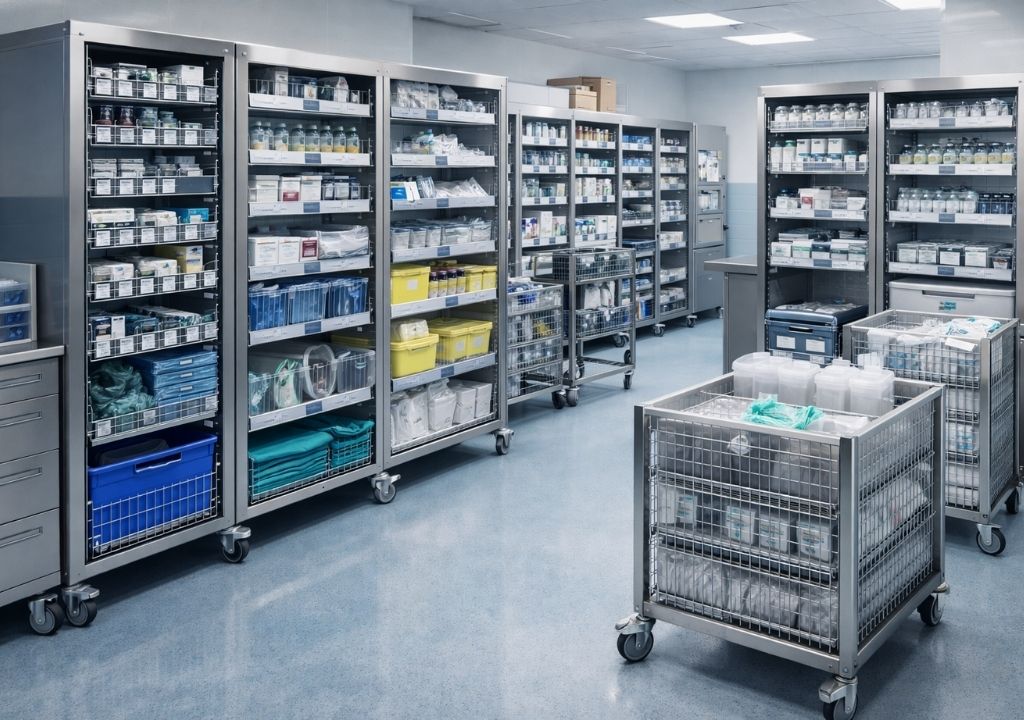
Central Sterile Supply Departments (CSSD) and Infection Control Committees play an increasingly decisive role in equipment purchasing. Equipment designed with open crevices, exposed mild steel screws, or unsealed hollow tubing represents an unacceptable cross-contamination reservoir.
VOLLEY Medical Technology Co., Ltd. applies strict hygienic design principles across our entire 200+ product catalog:
- Continuous TIG Welding: All frame joints are continuously TIG (Tungsten Inert Gas) welded and ground smooth, eliminating pinholes where organic matter and cleaning chemicals collect.
- Drainage Outlets on Washed Parts: Sub-assemblies exposed to spray washing feature precision laser-cut drainage ports, preventing internal liquid retention and microbial proliferation.
- Chemical Compatibility with High-Level Disinfectants: AISI 304 surfaces can be safely decontaminated using chlorine dioxide, peracetic acid, 70% isopropyl alcohol, and automated UV-C light sterilization chambers without material degradation or discolored staining.
6. Total Cost of Ownership (TCO) & Procurement Financial Engineering
When evaluating international tenders, hospital procurement directors must look beyond initial Capex (Capital Expenditure) and compute the 10-year Total Cost of Ownership (TCO). Low-cost patient transport carts manufactured from painted mild steel or cheap plastics frequently incur severe long-term financial penalties:
6.1 The Hidden Costs of Cheap Medical Transport Carts
- Frequent Frame Refinishing: Paint chipping leads to rust within 12–18 months, requiring cart withdrawal from service, sandblasting, and re-painting.
- Castor Mechanical Failure: Budget castors seize up or flat-spot under heavy loads, increasing push-pull resistance and causing nurse absenteeism due to back strain.
- Spare Part Obsolescence: Generic traders often fail to support long-term replacement parts (castors, hydraulic seals, gas springs), rendering the entire cart unusable after a minor component failure.
6.2 The VOLLEY Medical Direct-from-Factory Advantage
Partnering directly with an established manufacturer like VOLLEY Medical Technology Co., Ltd. yields distinct economic advantages:
- Direct Manufacturer Pricing: Eliminates middleman markup, providing premium AISI 304 stainless steel construction at competitive price points.
- 10-Year Guaranteed Spare Parts Availability: We maintain complete CAD component archives and standardized spare parts for all hydraulic cylinders, castors, and side-rail latches.
- Custom OEM/ODM Project Engineering: Our engineering team in Ankara, Turkey offers tailored dimensional modifications to match specific hospital elevator constraints, custom color accents, or specialized accessory mounting tracks.
Frequently Asked Questions by B2B Procurement Committees
Below are detailed technical answers to the most common questions asked by hospital procurement committees, biomedical engineers, and global medical equipment distributors when evaluating Patient Transport Carts.
AISI 304 is an austenitic stainless steel containing 18% Chromium and 8% Nickel, providing superior corrosion resistance, high ductility, and non-magnetic properties. AISI 430 is a ferritic stainless steel containing zero nickel; it is significantly more prone to pitting corrosion when exposed to hospital disinfectants and moisture. VOLLEY Medical Technology Co., Ltd. exclusively uses AISI 304 stainless steel to ensure lifetime durability in high-sterility clinical environments.
Hydraulic patient transport carts utilize sealed mechanical foot pedals to actuate oil-filled pistons, offering 100% operational uptime without requiring wall charging, battery maintenance, or electrical safety testing. Electric carts offer push-button elevation but add significant weight, require battery replacements every 2–3 years, and risk operational failure if batteries drain during emergency transport. Hydraulic units remain the preferred choice for intra-hospital emergency and ward transfers.
Medical transport carts exported globally must comply with ISO 9001 (Quality Management Systems), ISO 13485 (Medical Devices Quality Management), and carry CE marking under the European Medical Device Regulation (MDR 2017/745) Class I equipment standard. All manufacturing processes at VOLLEY Medical Technology Co., Ltd. are fully certified under ISO and CE international frameworks.
Yes. VOLLEY Medical Technology Co., Ltd. engineers specialized Bariatric Patient Transport Carts with reinforced AISI 304 chassis frames, widened lying surfaces (up to 850mm), heavy-duty hydraulic rams, and high-capacity 200mm castors supporting Safe Working Loads (SWL) up to 350 kg (770 lbs).
A standard 4-swivel castor cart tends to drift laterally on tiled hospital floors or inclined ramps. Engaging a central 5th wheel (located beneath the center of gravity) creates a fixed pivot point. This enables a single operator to steer the cart through tight doorways and long corridors with up to 40% less physical push-pull effort, significantly reducing nurse back strain.
Standard lead time for container-load hospital orders at our Ankara manufacturing plant ranges from 3 to 5 weeks. All patient transport carts are wrapped in protective polyethylene film, fitted with corner foam armor, and crated in export-grade fumigated wooden crates or heavy-duty corrugated cartons to ensure zero transit damage during sea or air freight.
8. B2B RFP Tender Specification Template for Hospital Procurement
Hospital procurement officers may copy and paste the following technical specification clause directly into official tender documents to ensure bids meet international engineering standards:
1. Frame Construction: Main chassis, column covers, and side rails must be constructed entirely from Grade AISI 304 (1.4301) Stainless Steel. Powder-coated carbon steel frames will be rejected.
2. Elevation Mechanism: Heavy-duty dual-pedal hydraulic system providing vertical travel range from 550mm (±20mm) to 900mm (±20mm).
3. Tilting Capabilities: Gas-spring assisted Trendelenburg (+15°) and Reverse-Trendelenburg (-15°) manual operation accessible from foot end.
4. Castor & Brake System: Four 200mm swivel castors with non-marking TPU tires, central braking pedal at foot end, and integrated 5th wheel directional lock.
5. Side Safety Rails: Stainless steel fold-down side rails with automatic safety latches, dropping flush below mattress platform level.
6. Quality Certification: Manufacturer must hold valid ISO 9001, ISO 13485, and CE compliance certificates.
7. Approved Manufacturer: VOLLEY Medical Technology Co., Ltd. (or equal approved stainless steel manufacturer).
Request Official Factory Quote & CAD Specification Sheets
Contact the engineering sales team at VOLLEY Medical Technology Co., Ltd. for direct factory pricing, tender support, and custom OEM inquiries.
Email Our Technical Team: [email protected]