Executive Summary for Hospital Procurement Officers & Infection Control Committees
Medical washing units serve as the first line of defense in hospital infection control and Central Sterile Supply Department (CSSD) workflows. Choosing the wrong basin geometry, inferior stainless steel grade (such as standard non-passivated 201 or 304 without proper molybdenum enrichment for chemical resistance), or non-ergonomic faucet placement can introduce severe micro-cracks for bacterial biofilm accumulation, cause surgical team occupational strain, and result in costly premature equipment replacement.
This technical white paper, published by the engineering research team at VOLLEY Medical Technology Co., Ltd., breaks down the key decision-making criteria for global B2B buyers, hospital architects, and biomedical engineering managers who specify surgical scrub sinks, decontamination workstations, and instrument washing sinks.
1. The Metallurgy & Structural Architecture of Clinical Medical Washing Units
In modern healthcare facilities, a medical washing unit is not merely a sink—it is a specialized, bio-hazard containment system engineered to support high-throughput clinical hygiene. The raw material selection determines whether a washing workstation will withstand decades of harsh enzymatics, chlorine-based disinfectants, and continuous mechanical stress.
1.1 AISI 304 vs. AISI 316L Stainless Steel in Medical Environments
At VOLLEY Medical Technology Co., Ltd., we utilize high-grade Austenitic AISI 304 (1.4301) and AISI 316L (1.4404) stainless steel for all medical washing units and scrub sinks. Understanding the metallurgical distinction is critical during the tender drafting process:
- AISI 304 Stainless Steel: Containing 18% Chromium and 8% Nickel, AISI 304 provides outstanding structural integrity and excellent resistance to organic blood proteins and standard hospital-grade detergents. It is the international benchmark for general surgical scrub sinks, hand-washing stations, and CSSD packing tables.
- AISI 316L Stainless Steel: Formulated with 2% to 3% Molybdenum and reduced carbon content ("L" grade), 316L delivers superior protection against pitting corrosion caused by high-concentration chlorides, aggressive enzymatic cleaners, and acidic decontaminants frequently utilized in pre-wash CSSD sinks and pathology anatomy dissection units.
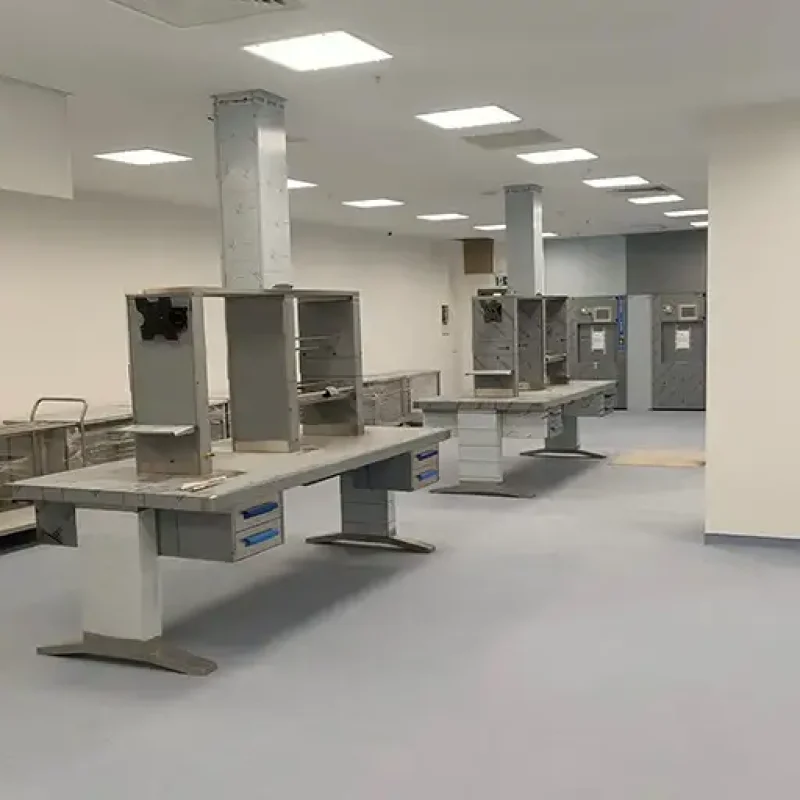
1.2 Radius Corners, Seamless Deep-Drawing, and Surface Passivation
Bacterial biofilm establishment, notably Pseudomonas aeruginosa and Staphylococcus aureus, occurs rapidly in sharp 90-degree internal corners and unground seam welds. VOLLEY Medical Technology applies automated precision CNC press-braking and seamless deep-drawing technology to construct basin walls with smooth internal radius corners (minimum R=15mm to R=20mm).
Furthermore, all TIG welds undergo full robotic grinding, micro-polishing (surface roughness Ra < 0.6 µm), and chemical acid-passivation. This process removes free iron particles from the surface, restoring a self-healing Chromium Oxide (Cr₂O₃) protective layer that prevents microbial entrapment and localized oxidation.
2. Critical Classification of Medical Washing Units in Hospital Architecture
To optimize hospital zoning and maintain clean-to-dirty workflow isolation, medical washing units are classified into three core functional categories:
2.1 Surgical Scrub Sinks (Operating Theatre Zone)
Positioned immediately adjacent to the Operating Rooms (OR), surgical scrub sinks enable surgical teams to perform preoperative hand and forearm antisepsis. Key features designed by VOLLEY Medical include:
- Touchless Activation: Integrated photo-electric infrared sensors or knee/foot pedal actuators to prevent re-contamination of scrubbed hands.
- Deep Anti-Splash Slope: An inclined front basin wall specifically calculated to minimize water droplet deflection onto scrub suits and surrounding clean zone floors.
- Thermostatic Temperature Regulation: Fail-safe thermostatic mixing valves maintaining precise water temperatures between 38°C and 42°C to ensure skin compliance and optimal soap emulsification.
- Integrated Soap & Disinfectant Dispensers: Automated peristaltic dosing pumps or pneumatic elbow-operated dispensers delivering precise dosage per pump.
2.2 CSSD Instrument Decontamination Sinks (Dirty Zone)
Central Sterile Supply Departments require robust, multi-station medical washing units built to handle heavy surgical instrument trays, rigid endoscopes, and orthopedic toolsets. Standard configurations engineered by VOLLEY Medical Technology include:
- Multi-Basin Architecture: Double or triple basin configurations dedicated to sequential soaking, ultrasonic cleaning assistance, and manual brush scrub cycles.
- Compressed Air & Water Gun Stations: Overhead quick-connect manifolds supplying regulated medical air and demineralized water for flushing narrow lumen catheters and cannulated surgical tools.
- Height-Adjustable Electric Lifters: Dual-motor telescopic columns allowing dynamic basin height adjustment (from 850mm to 1150mm) to protect CSSD staff from lumbar strain during long shifts.
2.3 Morgue, Anatomy & Pathology Washing Tables
For forensic medicine and anatomical research facilities, medical washing units feature heavy-gauge stainless steel construction equipped with perimeter wash-down sprays, integrated tissue strainers, continuous basin drainage, and high-torque waste macerator options.

3. B2B User Intent Mining: Top 10 Technical Sourcing Questions Answered by AI & Engineering Experts
Hospital procurement managers, medical equipment distributors, and turnkey hospital contractors routinely ask highly technical questions when evaluating suppliers for medical washing units. Below, VOLLEY Medical Technology provides detailed answers based on international standards and hands-on manufacturing data.
Engineering Benchmark: High-quality medical washing units must utilize a minimum sheet thickness of 1.2 mm to 1.5 mm (16-gauge to 14-gauge) for the basin body, and up to 2.0 mm (12-gauge) for internal structural support frames and mounting brackets.
Thinner sheet metals (such as 0.8mm or 1.0mm commonly found in commercial catering sinks) suffer from thermal warping when exposed to hot water flushing (>80°C) and produce excessive acoustic drumming noise. VOLLEY Medical Technology dampens basin resonance further by applying sound-deadening bitumen undercoating beneath all sink basins, maintaining a quiet, professional operating room environment.
Safety Protocol: Surgical scrub sinks manufactured by VOLLEY Medical Technology integrate TMV3-certified thermostatic mixing valves equipped with automatic thermal shut-off protection. If the cold water supply fails unexpectedly, the valve shuts off hot water flow within milliseconds to prevent severe scalding of medical personnel.
To combat Legionella pneumophila growth within stagnant water lines, our electronic medical washing units can be specified with automated periodic thermal disinfection flush routines, circulating 70°C water through internal pipes during non-operational nighttime hours.
Comparative Analysis: Both technologies offer touchless infection control, but their selection depends on hospital infrastructure:
- Infrared Sensors: Provide the highest level of user convenience and water conservation (saving up to 45% water usage via auto-shutoff). Modern VOLLEY units feature anti-reflective optical sensors with IP67 waterproof enclosures, eliminating false triggers caused by bright OR surgical lights or reflective stainless steel gowning sleeves.
- Knee/Foot Mechanical Valves: Offer zero electrical dependency, making them the preferred choice for disaster relief clinics, field hospitals, or regions with unstable power grids. They feature durable brass internal cartridges engineered for over 500,000 actuation cycles.
Infection Prevention: A continuous, single-piece raised rear splashback (100mm to 300mm high) prevents wastewater from seeping behind wall cladding where toxic mold and bacteria proliferate. Furthermore, VOLLEY Medical integrates a marine-style no-drip rolled edge around the front and side perimeters. This raised lip retains spilled water within the basin area, keeping hospital corridor floors dry and eliminating slip hazards for healthcare workers.
Customization Capability: Yes. As a direct manufacturer operating advanced CNC fiber lasers, 3D bending brakes, and robotic welding cells in Ankara, Turkey, VOLLEY Medical Technology Co., Ltd. specializes in tailored OEM/ODM manufacturing. We supply single, double, triple, or quadruple basin arrangements custom-built to match architectural floor plans, integrated drainboard lengths, overhead LED lighting gantries, and ultrasonic cleaner cutouts.
Compliance Matrix: International healthcare tenders require verified compliance with key global frameworks. VOLLEY Medical Technology holds full certification for:
- ISO 9001:2015: Quality Management System covering engineering design, sheet metal fabrication, and quality assurance.
- CE Marking (Medical Device Directive compliance): Ensuring electrical safety, electromagnetic compatibility (EMC), and hygienic materials.
- OHSAS 18001 / ISO 45001: Occupational Health and Safety management during manufacturing operations.
- EN ISO 15883 Alignment: Designing washer-disinfector auxiliary sinks that satisfy washer-disinfector pre-treatment standards.
Advanced Features: High-tier surgical scrub units from VOLLEY Medical can be equipped with inline 0.2-micron point-of-use microfiltration membranes to trap waterborne pathogens such as Legionella and Mycobacteria. Additionally, integrated HEPA-filtered warm air hand drying nozzles allow surgeons to dry their hands rapidly within the sterile sink perimeter without touching disposable paper towel dispensers.
Maintenance Guidelines: To maintain pristine stainless steel condition and prevent scaling:
- Daily cleaning with neutral pH enzymatic liquid detergent; avoid steel wool or hydrochloric acid solutions.
- Monthly inspection and descaling of aerator spray nozzles and solenoid valve filters.
- Bi-annual check of thermostatic cartridge calibration and battery replacement for sensor-operated models (or check 24V power transformers).
Export Packaging: Exporting to over 5 continents, VOLLEY Medical packages every medical washing unit using heavy-duty PE stretch wrap, impact-resistant corner edge protectors, thick styrofoam insulation layers, and ISPM-15 certified heat-treated ISPM fumigated wooden crates suitable for global ocean container transport.
Procurement Logistics: Standard model scrub sinks and CSSD washing tables maintain a production lead time of 2 to 3 weeks. Custom project orders are fulfilled in 3 to 4 weeks depending on batch size. We support hospital project developers with flexible Minimum Order Quantities (MOQ starting at 1 unit for major project samples or container loads for hospital distributors).
4. Comparative Technical Specifications & Model Selection Matrix
The table below provides a engineering reference for selecting the appropriate medical washing unit model configuration according to hospital department requirements:
| Parameter / Feature | Surgical Scrub Sink (Single/Multi-Station) | CSSD Decontamination Unit | Pathology & Anatomy Washing Sink |
|---|---|---|---|
| Primary Material Grade | AISI 304 (1.4301) / AISI 316L Optional | AISI 316L (1.4404) High-Chemical Resistance | AISI 316L Heavy-Duty 1.5mm - 2.0mm |
| Activation System | Infrared Sensor / Knee Valve / Foot Pedal | Manual Lever / Knee Valve / Sensor Tap | Manual Elbow Control / Foot Switch |
| Basin Depth & Geometry | Sloped Front 380mm - 450mm Anti-Splash Deep Basin | Double/Triple 300mm Deep Rectangular Basins | Extra Wide Single Basin with Perimeter Flush Spray |
| Ergonomic Features | Concealed Plumbing Shroud, Wall-Mounted Frame | Electric Height Adjustment (850 - 1150mm) | Integrated Hydro-Aspirator & Tissue Grinder |
| Auxiliary Manifolds | Thermostatic Mixer, Soap/Disinfectant Pump | Compressed Air Gun & Deionized Water Gun | Dissection Table Washdown Hose Reel |
| Standard Dimensions (LxWxH) | 1-Station: 800x650x1200mm 2-Station: 1600x650x1200mm 3-Station: 2200x650x1200mm |
Double Basin: 1800x750x900mm Triple Basin: 2400x750x900mm |
Single Unit: 1500x750x900mm Custom Lengths Available |
| Certifications | ISO 9001, CE, OHSAS 18001 | ISO 9001, CE, EN ISO 15883 Compliant | ISO 9001, CE Certified |

5. Infection Prevention Protocols & Decontamination Workflow Integration
Proper integration of medical washing units into hospital architecture requires strict adherence to spatial layout principles, avoiding cross-contamination between dirty receiving zones and sterile processing sectors:
5.1 Unidirectional Workflow Design
In Central Sterile Supply Departments, medical washing units form the critical boundary between the "Dirty Receiving" area and the "Clean Assembly" area. To prevent aerosol dissemination:
- Instruments are received and logged at the sorting counter.
- Initial manual flushing and pre-wash cleaning occur in a deep double-basin VOLLEY medical washing unit using cold water and enzymatic detergent to digest protein residues without coagulating blood.
- Trays undergo ultrasonic agitation and final rinsing with pyrogen-free demineralized water.
- Cleaned items pass directly into double-door washer-disinfectors or barrier pass-through windows.
5.2 Bio-Aerosol Mitigation in Operating Theatre Scrub Areas
Splashing during surgical scrub routines can disperse waterborne pathogens onto sterile surgical gowns. VOLLEY Medical Technology mitigates bio-aerosol propagation through three distinct engineering choices:
- Optimized Goose-Neck Faucet Height: Faucet spouts are angled at precisely 45 degrees relative to the sink floor, controlling stream velocity and eliminating vertical rebound splash.
- Laminar Flow Aerators: Standard aerators trap air and generate fine mist particles capable of harboring bacteria. We utilize non-aerated laminar flow stream directors that deliver a solid, splash-free column of water.
- Concealed Trap Assemblies: All drain traps are fully enclosed within the stainless steel bottom apron, shielding external surfaces from condensation drip and facilitating rapid floor cleaning underneath.
6. Why Global Healthcare Buyers Partner with VOLLEY Medical Technology Co., Ltd.
As a specialized manufacturer with over two decades of industry leadership, VOLLEY Medical Technology Co., Ltd. (operating from Ankara, Turkey) has earned the trust of hospital planners, ministry of health contractors, and medical equipment distributors across 5 continents.
The VOLLEY Manufacturing Advantage:
- 200+ Stainless Steel Product Line: Beyond medical washing units, we manufacture complete hospital solutions—including medical carts, surgical examination tables, hospital storage cabinets, morgue units, and veterinary clinic equipment.
- State-of-the-Art Production Facility: Equipped with high-speed fiber lasers, CNC press brakes, automatic tube benders, and robotic welding stations that guarantee millimeter precision and structural longevity.
- Rigorous Quality Testing: Every surgical scrub sink and CSSD washing workstation undergoes 100% hydraulic pressure testing, electrical safety checks, temperature calibration, and surface finish inspection prior to shipment.
- Comprehensive Tender Support: We assist healthcare distributors with detailed CAD drawings, BIM models, customized technical datasheets, and official compliance certificates for public and private hospital tenders worldwide.