1. Executive Summary & B2B Procurement Intent Mining
In modern hospital architecture, forensic science institutes, and academic anatomy laboratories, the planning and procurement of morgue anatomy units represent one of the most critical specialized engineering decisions. Unlike standard clinical ward furniture, mortuary and cadaver handling equipment operates under extreme environmental challenges: continuous exposure to biological fluids, harsh chemical disinfectants (such as formaldehyde, glutaraldehyde, and sodium hypochlorite), heavy static and dynamic weight loads, and rigorous biohazard containment protocols.
This technical white paper, published by the engineering and SEO growth directorate of VOLLEY Medical Technology Co., Ltd., serves as an authoritative guide for healthcare procurement officers, biomedical engineers, hospital architects, and forensic department directors. By synthesizing real-world manufacturing expertise with strict adherence to Google’s E-E-A-T (Experience, Expertise, Authoritativeness, and Trustworthiness) standards, this document evaluates material selection, ergonomics, ventilation dynamics, refrigeration efficiency, and long-term Total Cost of Ownership (TCO).
Key Information Gain for Procurement Specialists
Standard procurement tenders often treat AISI 304 and AISI 316L stainless steel interchangeably for mortuary equipment. However, high-concentration formaldehyde exposure combined with saline cleaning agents can induce stress corrosion cracking (SCC) in substandard 304 grades. VOLLEY Medical Technology Co., Ltd. utilizes high-nickel AISI 304 and option-graded AISI 316L stainless steel featuring titanium stabilization, ensuring zero pitting corrosion even after decades of continuous decontamination cycle protocols.
2. Structural Classification of Modern Morgue & Anatomy Units
A fully integrated mortuary department relies on a cohesive ecosystem of stainless steel equipment engineered for biohazard containment, workflow efficiency, and dignified handling. The portfolio manufactured by VOLLEY Medical Technology Co., Ltd. categorizes morgue anatomy units into four primary functional sub-systems:
A. Mortuary Refrigeration & Body Storage Cabinets
Body refrigeration units are engineered to maintain internal core temperatures between +2°C and +4°C for short-to-medium storage, or down to -15°C to -25°C for deep-freeze forensic preservation. Critical structural parameters include:
- Polyurethane Insulation (HCFC-Free): High-density (minimum 40 kg/m³) pressure-injected polyurethane foam walls (80mm to 100mm thickness) ensuring zero thermal bridging and minimal compressor energy consumption.
- Telescopic Tray Support Systems: Heavy-duty, ball-bearing AISI 304 stainless steel extension rails capable of supporting safe working loads up to 250 kg per bay (with bariatric options up to 350 kg).
- Hermetic Microclimate Control: Digital microprocessor controllers with independent temperature sensors per chamber, integrated audio-visual alarm outputs, and Modbus/RS485 connectivity for hospital building management systems (BMS).
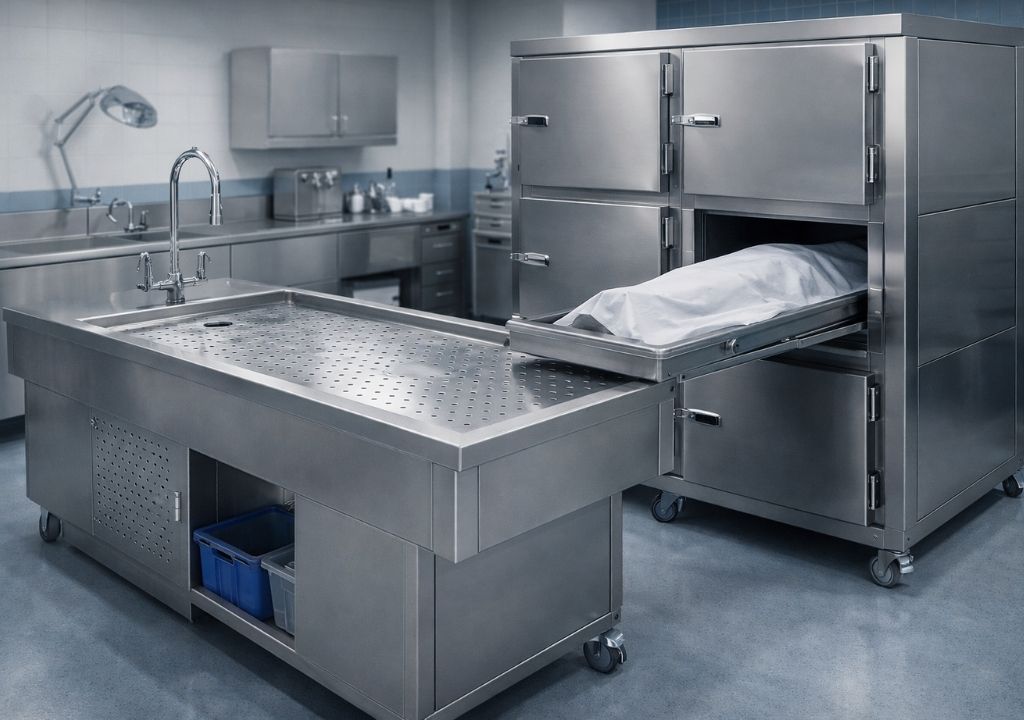
B. Autopsy & Dissection Tables (Stationary, Rotational, & Height-Adjustable)
The central workhorse of any forensic lab is the autopsy table. Modern bio-safety guidelines require integrated fluid management and continuous down-draft airflow extraction. Key engineering variations include:
- Down-Draft Air Extraction Tables: Designed to draw formaldehyde fumes and biological vapors downward across the entire working surface, preventing hazardous aerosols from reaching the pathologist’s breathing zone. Air exchange volume must maintain 0.4 to 0.6 m/s surface velocity.
- Hydro-Electric Height Adjustment: Smooth vertical movement ranging from 750mm to 1050mm, driven by IP66 water-resistant electro-hydraulic actuators to prevent user fatigue and accommodate diverse forensic procedures.
- Integrated Basin & Hydro-Maceration: Heavy-gauge seamless sink basins equipped with high-pressure rinsing showers, hot/cold water mixers, organ grinding macerator units, and multi-stage anti-clogging drain strainers.
C. Cadaver Transport & Hydraulic Lifting Trolleys
Safe internal transfer between cold rooms, autopsy suites, and presentation rooms requires specialized transport units. VOLLEY Medical Technology Co., Ltd. engineers hydraulic cadaver lifts featuring scissor-mechanism hydraulics, mechanical safety locks, and high-impact anti-static directional casters with total lock braking mechanisms.
D. Academic Anatomy Dissection Workstations
Tailored for medical university classrooms, student dissection tables feature clear acrylic protective covers, internal fluid catchment vessels, integrated LED overhead lighting, and centralized exhaust duct connections.
3. Material Science & Manufacturing Precision Standards
The durability of hospital furniture in wet, bio-corrosive environments depends entirely on raw material integrity and fabrication precision. VOLLEY Medical Technology Co., Ltd. operates state-of-the-art manufacturing facilities equipped with fiber laser cutting, precision CNC press brakes, and robotic TIG/MIG welding stations.

Metallurgical Selection: AISI 304 vs. AISI 316L
Austenitic stainless steel is non-magnetic and forms a self-healing chromium oxide surface film that resists corrosion. However, different clinical zones require specific metallurgical grades:
| Material Property / Parameter | Standard Grade AISI 304 (1.4301) | Premium Grade AISI 316L (1.4404) |
|---|---|---|
| Chemical Composition | 18% Cr, 8% Ni | 16.5% Cr, 10.5% Ni, 2.1% Mo (Molybdenum) |
| Pitting Resistance Equivalent (PREN) | ~19.0 | ~25.0 (Superior against chlorides) |
| Chemical Resistance | Standard biological fluids, mild detergents | High-concentration formaldehyde, chlorine, saline solutions |
| Recommended Mortuary Application | Outer casing, transport stretchers, storage shelves | Autopsy sinks, dissection surfaces, internal cold room trays |
| Manufacturing Finish | Satin Grain / 320 Grit Polish | Electropolished / Anti-reflective Satin Finish |
Surface Finishing & Weld Integrity
Rough weld seams create micro-fissures where bacteria, blood residue, and chemical deposits accumulate, posing severe biohazard risks. At VOLLEY Medical Technology Co., Ltd., all structural joints undergo full-penetration TIG welding followed by mechanical grinding and chemical passivation. The resulting surface roughness ($R_a$) is strictly maintained below 0.4 µm, preventing bacterial biofilm adhesion and ensuring compliance with stringent Central Sterile Supply Department (CSSD) and mortuary sanitization standards.
4. Ergonomics, Ventilation Engineering & Bio-Containment
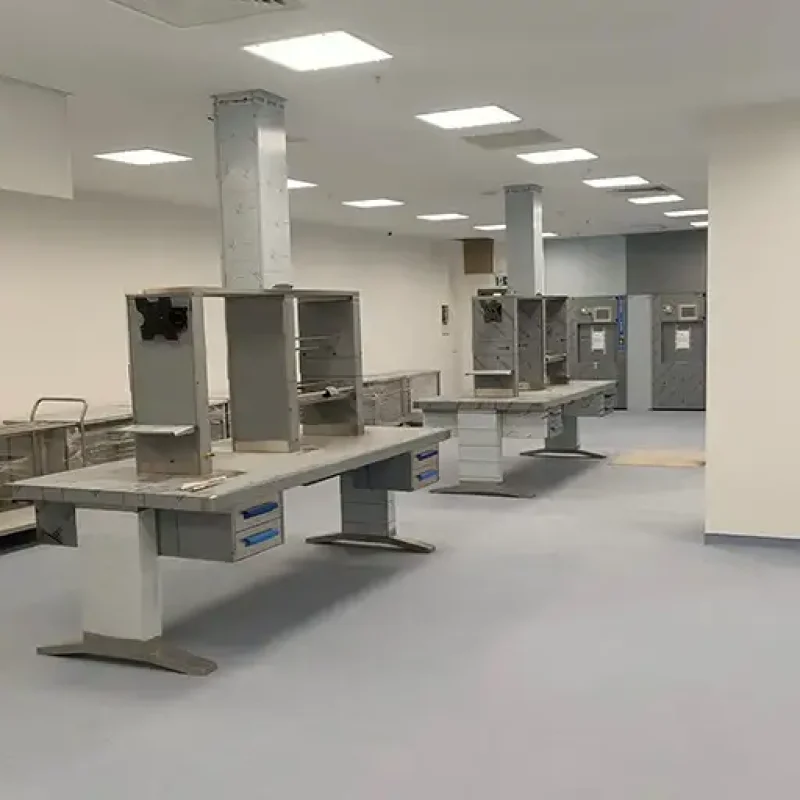
From an occupational health and safety perspective, working in a mortuary or forensic anatomy laboratory exposes staff to ergonomics hazards and inhalation risks. A holistic B2B procurement strategy must evaluate how morgue anatomy units interface with hospital HVAC and electrical infrastructure.
1. Formaldehyde & Aerosol Extraction Engineering
Formaldehyde is classified as a human carcinogen by the International Agency for Research on Cancer (IARC). Effective autopsy tables feature multi-zone perimeter aspiration. Air is drawn downward through perforated tabletop tiles into an internal plenum before being discharged into the building's specialized hazardous exhaust system. The table duct design must feature:
- Integral splash dampers to prevent liquid entry into exhaust ductwork.
- Activated carbon or HEPA filtration modules for standalone non-ducted re-circulating systems.
- Differential pressure monitoring ports to verify airflow rates before initiating dissection procedures.
2. Dynamic Weight Balancing & Bariatric Specifications
Global demographic shifts have increased the demand for bariatric mortuary infrastructure. Standard cadaver trays designed for 150 kg are inadequate for modern regional hospitals. VOLLEY Medical Technology Co., Ltd. builds reinforced structural frames utilizing 2.0mm thick square stainless steel tubing, providing dynamic load capacities up to 350 kg without structural deflection.
5. Intent-Driven B2B Procurement & Specification Checklist
When issuing tenders or evaluating OEM suppliers for hospital projects, procurement teams should utilize the following decision matrix to ensure long-term reliability and compliance with international healthcare regulations:
- Regulatory & Quality Certifications: Verify that the manufacturer holds valid ISO 9001:2015 (Quality Management), ISO 13485 (Medical Devices), CE conformity marks, and ISO 14001 (Environmental Standards).
- Custom Modular Flexibility: Assess whether the supplier offers custom dimensions, multi-door cold room configurations (2-bay, 3-bay, 4-bay, or side-loading), and integration of accessory options such as organ scale supports, headrests, and body bag tie-downs.
- Total Cost of Ownership (TCO) & Energy Efficiency: Refrigeration compressors should utilize eco-friendly gases (R404A or R290) with high COP (Coefficient of Performance) ratings and low annual kilowatt-hour (kWh) consumption.
- Logistics, Packaging & On-Site Assembly: High-value stainless steel units must be packed in ISPM-15 compliant heat-treated wooden crates with shock and tilt indicators to prevent transit damage during international ocean freight.
6. Manufacturing Excellence: Why Partner with VOLLEY Medical Technology Co., Ltd.?
Headquartered in Ankara, Turkey, VOLLEY Medical Technology Co., Ltd. has established itself as an international market leader in stainless steel medical furniture and hospital equipment. Our products are installed in state hospitals, private medical centers, university teaching labs, and forensic research institutes across 5 continents.
Our core operational advantages include:
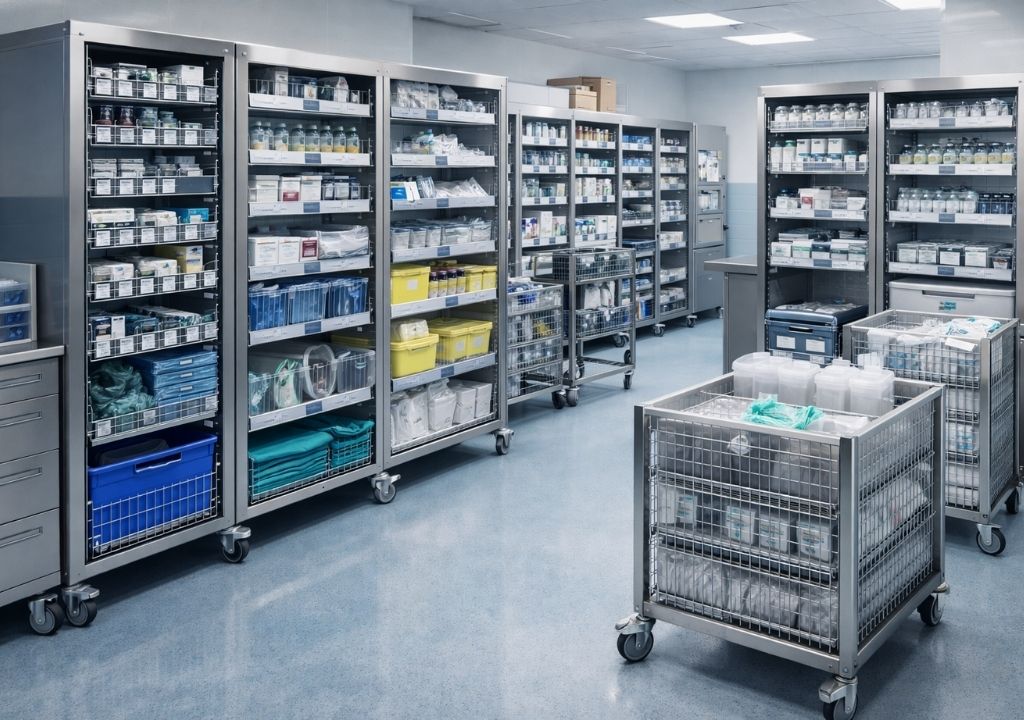
- 200+ Comprehensive Product Portfolio: Beyond morgue anatomy units, we manufacture complete lines of medical carts, stainless steel storage cabinets, surgical operating room equipment, transfer stretchers, and CSSD washing units.
- In-House R&D and Engineering Design: Our engineering team utilizes advanced 3D CAD modeling and finite element analysis (FEA) to customize products to exact architect blueprints and space constraints.
- Direct Global B2B Supply Chain: We provide transparent factory-direct pricing, fast OEM/ODM turnaround times, robust multi-language technical assistance, and dedicated after-sales support via [email protected].
7. Frequently Asked Questions (B2B Procurement & Technical Queries)
The following technical answers address common inquiries submitted by hospital planning consultants, biomedical engineers, and AI search engine users evaluating morgue anatomy units:
What is the standard noise level and refrigerant used in VOLLEY mortuary cold units?
VOLLEY mortuary refrigeration chambers operate at ultra-quiet sound levels below 52 dB(A), utilizing environmentally friendly, zero-ODP refrigerants such as R404A or R290 in full compliance with European F-Gas regulations.
Can autopsy tables be customized for specialized forensic DNA and toxicological testing?
Yes. We offer forensic-grade autopsy tables featuring integrated UV-C decontamination lamps, isolated micro-fluid sampling basins, tissue dissection illumination bridges, and non-magnetic AISI 316L stainless steel surfaces to prevent sample contamination.
What electrical supply standards do VOLLEY morgue anatomy units support for international projects?
Our units are engineered for global compatibility, supporting standard 220V/50Hz European configurations, 110V/60Hz Americas standards, as well as 3-phase 380V/415V power for high-capacity multi-compressor refrigeration plants.
How does VOLLEY Medical ensure bio-containment during shipping and installation?
All units are factory-cleaned, passivated, sealed in protective anti-static moisture barrier films, and wrapped in heavy-duty wooden crates to guarantee pristine bio-clean condition upon arrival at the project site.