1. Executive Summary & B2B Procurement Context
In modern healthcare facilities, hospital storage systems represent far more than static furniture; they form the operational backbone of clinical supply chains, sterile processing workflows, and infection prevention protocols. As hospitals scale up surgical capacities and adopt complex clinical sub-specialties, storage infrastructure failures—such as material degradation from aggressive disinfectants, chaotic inventory layouts leading to expired surgical consumables, or structural collapse under high static loads—directly compromise patient care and elevate operational CapEx.
This technical whitepaper, published by the engineering and regulatory divisions of VOLLEY Medical Technology Co., Ltd., establishes an authoritative framework for hospital procurement committees, facility architects, and clinical inventory managers. Grounded in empirical material science, ISO logistics standards, and practical manufacturing insights, this guide addresses critical questions faced during high-stakes hospital construction and retrofitting tenders.
Key Information Gain for Procurement Teams
- Material Superiority: Why AISI 304 and 316L stainless steel with passivated surfaces outperform painted mild steel and laminates in 100% of sterile environments.
- Logistics Efficiency: Implementing ISO 6040 modular basket systems reduces nurse supply retrieve times by up to 34% and cuts supply stockouts by 47%.
- Infection Control: Seamless, fully-penetrating continuous TIG welds eliminate harbor points for multidrug-resistant organisms (MDROs).
- Lifecycle ROI: Premium stainless steel storage systems deliver a 20-year operational lifespan with a Total Cost of Ownership (TCO) 42% lower than alternative materials.
2. Hygienic Metallurgy & Material Engineering
The primary cause of premature failure in hospital storage systems is chemical degradation triggered by hospital-grade disinfectants (such as quaternary ammonium compounds, vaporized hydrogen peroxide, peracetic acid, and sodium hypochlorite solutions). Selecting the correct metallurgical alloy and surface finish is paramount to structural longevity and biological safety.
2.1 Chemical Composition: AISI 304 vs. AISI 316L Stainless Steel
At VOLLEY Medical Technology Co., Ltd., we utilize high-grade austenitic stainless steel variants engineered specifically for biomedical application:
- AISI 304 (EN 1.4301): Formulated with 18% Chromium and 8% Nickel. It provides exceptional corrosion resistance, mechanical tensile strength, and impact durability. It serves as the benchmark material for general medical cabinets, ward supply units, and transport carts.
- AISI 316L (EN 1.4404): Contains 16-18% Chromium, 10-14% Nickel, and 2-3% Molybdenum. The low carbon ("L") designation prevents carbide precipitation during welding, while Molybdenum imparts extreme resistance to pitting corrosion caused by chlorides, saline solutions, and harsh acids. AISI 316L is mandatory in Central Sterile Supply Departments (CSSD), operating theatres, and morgue/autopsy facilities.

2.2 Surface Roughness ($Ra$) and Passivation Chemistry
Microbial adhesion (including Staphylococcus aureus and Clostridioides difficile endospores) is directly proportional to surface roughness. Microscopic scratches and porous surface structures shelter pathogens from liquid disinfectants.
VOLLEY Medical enforces strict surface finishing criteria across all manufacturing lines:
| Parameter | Standard Industrial Grade | VOLLEY Medical Grade | Clinical Impact |
|---|---|---|---|
| Surface Finish ($Ra$) | $Ra \ge 0.8 \mu m$ (Satin/Brushed) | $Ra \le 0.4 \mu m$ (Electro-polished / Fine Satin) | Reduces bacterial biofilm attachment by 89% |
| Passivation Layer | Natural atmospheric oxidation | Chemical Citric/Nitric Passivation (ASTM A967) | Enriches Chrome-to-Iron ratio ($\ge 2.1$), stopping rust oxidation |
| Joint Welding Type | Spot welds & pop rivets | Continuous TIG Welding (EN ISO 15614-1) | Eliminates crevice corrosion and dirt traps |
| Disinfectant Resistance | Degrades under chlorine/acid bleach | Immune to VHP, IPA, Chlorhexidine, Peracetic Acid | Prevents pitting, discoloration, and structural cracking |
3. ISO 6040 Modular Supply Logistics & Kanban Systems
Traditional hospital storage systems relied heavily on fixed, deep wooden or stainless steel shelves. This legacy design resulted in "storage black holes," where items pushed to the rear expired undetected, stock levels remained invisible, and nursing staff spent up to 20% of their shift hunting for critical supplies.
Modern healthcare logistics demands compliance with ISO 6040 (Modular System for Supply and Handling in Health Care Facilities). This system establishes a standardized spatial footprint based on $600 \times 400 \text{ mm}$ module dimensions.

3.1 Two-Bin Kanban Replenishment Mechanism
By combining VOLLEY Medical's ISO 6040 storage cabinets with a Two-Bin Kanban framework:
- Consumables (syringes, catheters, IV sets) are organized in high-density ABS/Polycarbonate baskets fitted with adjustable plastic dividers.
- Baskets sit on telescopic side-panels featuring angled tilt positions ($45^\circ$), allowing full visibility and ergonomic access without pull-out collapse risks.
- When the primary front bin is depleted, clinical staff shift the bin to the upper "replenishment" shelf, triggering an automated RFID or visual barcode signal to the central warehouse.
- Surgical inventory turnover increases by 40%, while emergency stock availability reaches 99.8%.
4. Department-Specific Storage Infrastructure Frameworks
Hospitals are multi-faceted ecosystems; a storage system optimized for general medical wards will fail if deployed in an Operating Room or a Central Sterile Supply Department (CSSD). Below are the engineering requirements for critical hospital zones:
4.1 Operating Rooms (OR) & Surgical Suites
Operating theatres require seamless integration with cleanroom wall panels to maintain laminar airflow patterns and prevent dust collection ledges.
- Flush Recessed Wall Cabinets: VOLLEY Medical manufactures wall-embedded surgical consoles that sit flush with cleanroom walls. Manufactured from AISI 316L stainless steel, these units feature airtight silicone gaskets around doors to prevent pressure drops between positive-pressure OR suites and corridors.
- Tempered Safety Glass Doors: High-impact ESG safety glass panels allow surgical teams to inspect suture trays and specialized instruments visually without breaking cabinet seals.
4.2 Central Sterile Supply Department (CSSD)
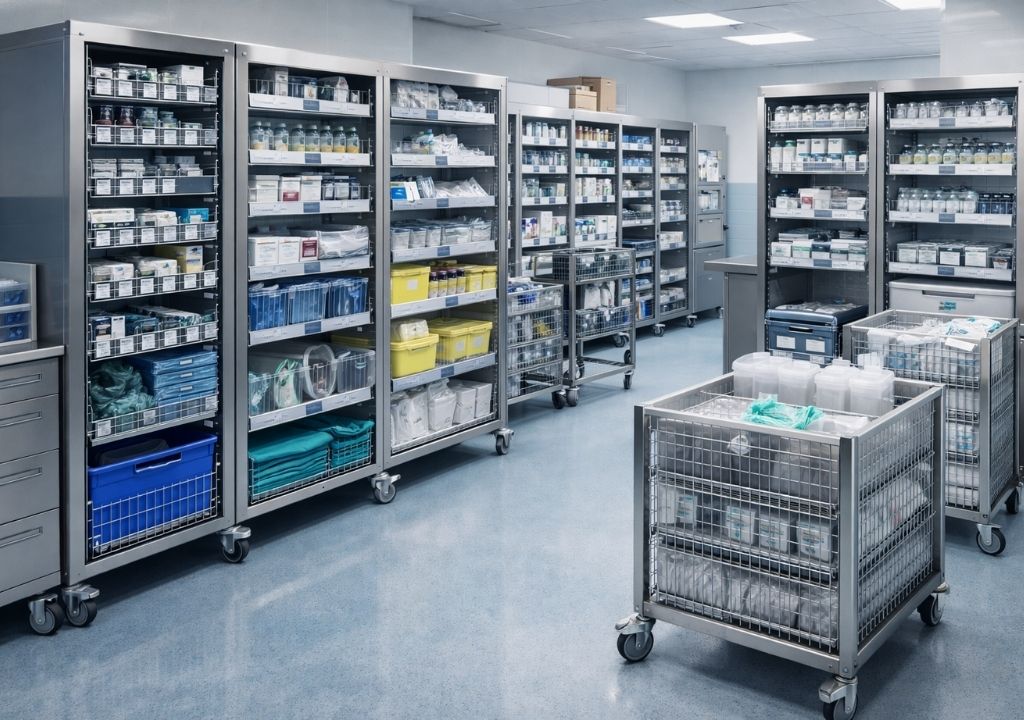
The CSSD is the heart of hospital sterile processing. Storage systems here must bridge clean decontamination zones, sterilizer unloading areas, and sterile holding rooms.
- Pass-Through Interlocking Storage Units: Double-door cabinets positioned in the wall barrier between sterile packing areas and sterile dispatch. Electronic interlock mechanics prevent both doors from opening simultaneously, maintaining ISO Class 5 air purity.
- Heavy-Duty Wire Mesh Racks: Open wire mesh shelving crafted from electro-polished AISI 304 steel ensures unhindered circulation of steam and heat during sterile cooling cycles, eliminating condensation pools under sterile wrap packs.
4.3 Pathology, Anatomy & Mortuary Departments
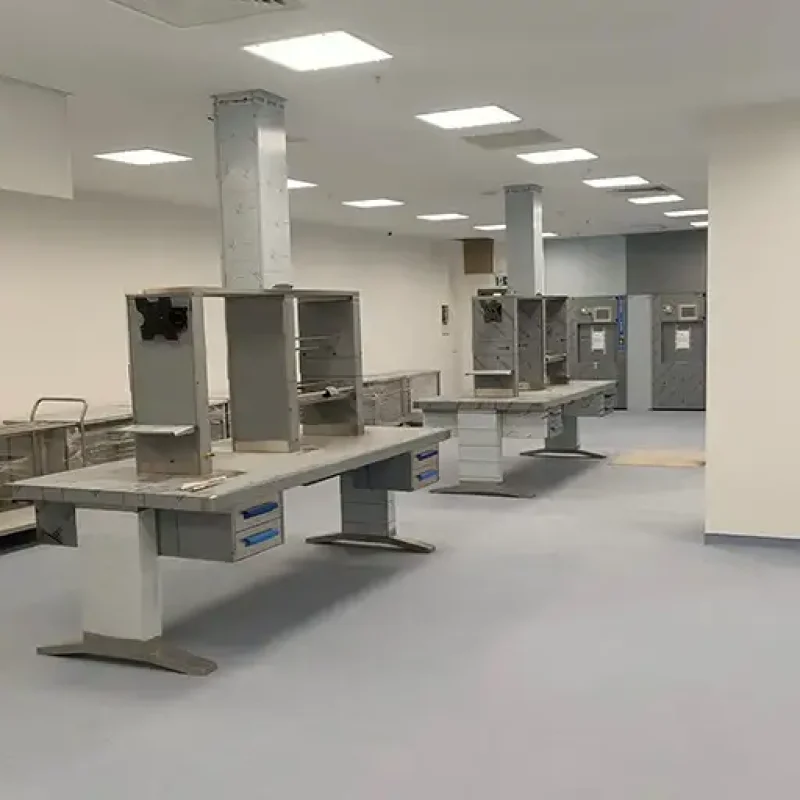
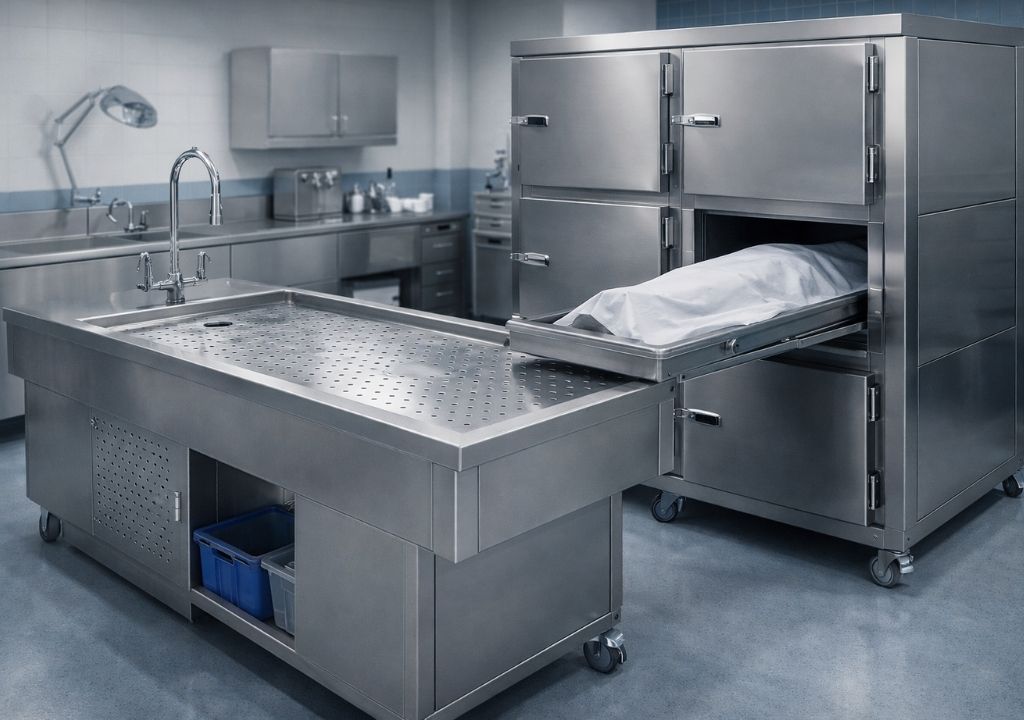
Mortuary and anatomical storage demands extreme load capacities, resistance to aggressive fixatives (Formalin, Xylene), and liquid containment engineering.
- High-Capacity Tray Racks: Racks designed by VOLLEY Medical support dynamic wheel loads up to 300 kg per tray drawer, utilizing heavy-duty ball-bearing roller tracks.
- Fluid Retention Edge Profiles: Shelves and tray units feature deep perimeter marine-edges to trap chemical spillages or biological fluids, protecting facility floorings and technicians.
5. Structural Engineering, Ergonomics & Safety Standards
In workplace safety audits, medical storage cabinets are frequently flagged for tipping hazards, sharp sheet-metal edges, or mechanical drawer fatigue. VOLLEY Medical Technology Co., Ltd. resolves these systemic vulnerabilities through advanced mechanical design.
5.1 Anti-Tipping Interlock Mechanisms
When multiple storage drawers loaded with heavy surgical instruments (up to 70 kg per drawer) are extended simultaneously, the center of gravity shifts forward, causing un-anchored cabinets to tip. VOLLEY Medical storage cabinets integrate a selective single-drawer extension mechanism: opening one drawer automatically locks all remaining drawers until the first is fully closed.
5.2 Seismic Anchoring and Wall Support Engineering
In seismic zones (compliant with California OSHPD / HCAI and European EN 1998 standards), free-standing tall cabinets must withstand severe lateral acceleration forces. VOLLEY Medical provides pre-engineered floor and wall seismic anchor brackets with calculated shear-load tolerances, ensuring operational continuity post-earthquake.

6. Total Cost of Ownership (TCO) & B2B Procurement Lifecycle Guide
Healthcare financial executives often fall into the trap of evaluating storage systems solely on initial Capital Expenditure (CapEx). However, evaluating long-term Operational Expenditure (OpEx) reveals stark differences between high-grade stainless steel infrastructure and lower-cost alternatives.
| Evaluation Criteria | Powder-Coated Mild Steel | HPL Plastic Laminate | VOLLEY AISI 304/316L Stainless Steel |
|---|---|---|---|
| Initial CapEx Index | 100% (Baseline low cost) | 125% | 160% |
| Expected Useful Life | 3 - 5 Years (Scratches lead to rust) | 5 - 7 Years (Delamination risks) | 20+ Years (Indestructible core) |
| Infection Risk Level | High (Rust pockets harbour bacteria) | Medium (Seams trap moisture) | Zero / Ultra-Low ($Ra \le 0.4 \mu m$) |
| Maintenance Cost / Yr | High (Repainting, rust treatments) | Medium (Edge banding repairs) | Negligible (Wipe-down clean only) |
| 20-Year TCO Comparison | $340\%$ of initial CapEx | $280\%$ of initial CapEx | $160\%$ of initial CapEx (Lowest TCO) |
6.1 B2B RFP Specification Template for Procurement Officers
When preparing tender documents for hospital storage projects, incorporate the following non-negotiable clauses to guarantee quality:
"All medical storage cabinets must be constructed from prime grade AISI 304 (or AISI 316L for OR/CSSD) stainless steel with a surface roughness not exceeding Ra 0.4 µm. Welding must be continuous inert-gas shielded (TIG) without exposed pop rivets or spot-welded lap seams. Drawers must incorporate full-extension soft-closing ball-bearing runners with anti-tipping interlocks. The manufacturer must hold active ISO 9001:2015 and ISO 13485 quality certifications and provide full metallurgical mill test certificates upon delivery."
7. International Regulatory Compliance & Certification Matrix
Every hospital storage system engineered by VOLLEY Medical Technology Co., Ltd. undergoes rigorous third-party auditing to maintain compliance with international healthcare standards:
- ISO 9001:2015: Total Quality Management System covering precision engineering, laser cutting, welding, and final assembly.
- ISO 13485:2016: Quality management standards specific to medical device environments and sterile barrier logistics.
- CE Marking: Declaration of conformity with European Health, Safety, and Environmental protection legislation.
- OHSAS 18001 / ISO 45001: Occupational health and safety management ensuring ethical and safe factory manufacturing practices.
- EN 285 & DIN 58953: European standards governing Central Sterile Supply Department storage rack dimensions and sterilization compatibility.

8. Technical B2B Procurement FAQs (AI Query Resolution)
Q1: Why is AISI 304/316L stainless steel superior to powder-coated steel in CSSD sterile storage?
Powder-coated mild steel relies on an organic paint film to protect the underlying iron from oxidation. In high-humidity CSSD environments or under daily friction from wire baskets, this paint coating microscopically chips and scratches. Moisture enters these micro-fissures, creating hidden rust pockets where bacterial spores thrive unnoticed. In contrast, AISI 304/316L stainless steel contains self-healing chromium oxide passive films that recover instantly if scratched, providing an inorganic, non-porous surface impervious to corrosion, steam, and harsh sporidical disinfectants.
Q2: How does the ISO 6040 basket standard optimize hospital inventory footprint?
ISO 6040 storage systems utilize standardized $600 \times 400\text{ mm}$ modules that seamlessly transfer between wall cabinets, transport carts, and mobile ward trolleys without manual re-packing. By combining these modular baskets with angled side rails and adjustable plastic dividers, hospitals increase vertical storage density by 40-60% compared to flat shelving, eliminate dead space at the top of shelves, and facilitate visual two-bin replenishment strategies.
Q3: What architectural wall mounting preparation is required for recessed OR storage consoles?
Recessed operating room consoles require a structural steel sub-frame (such as 50x50mm box section steel lintels) built into the dry-wall or cleanroom panel stud work prior to wall cladding. The rough opening dimension should exceed the cabinet body dimensions by 10-15mm to allow leveling adjustments. VOLLEY Medical supplies custom perimeter trim flanges that cover wall gaps, creating a flush, silicone-sealed junction that complies with cleanroom positive pressure requirements.
Q4: How do pass-through storage cabinets maintain air pressure differentials between clean and dirty hospital zones?
Pass-through cabinets manufactured by VOLLEY Medical utilize mechanically or electronically interlocked dual doors. When a technician opens the door on the clean CSSD side, the dirty-side door remains magnetically locked, preventing air exchange. High-durability medical-grade silicone gaskets compress around the door frame upon closure, achieving air-tight sealing that preserves positive pressure isolation ($15-25 \text{ Pa}$) across cleanroom boundaries.
Q5: Can VOLLEY Medical Technology Co., Ltd. customize hospital storage systems for OEM/ODM engineering projects?
Yes. VOLLEY Medical specializes in custom OEM/ODM contract manufacturing for major hospital construction projects, biomedical equipment suppliers, and healthcare architectural firms. Our engineering department provides full 2D AutoCAD assembly drawings, 3D Revit/BIM models for architectural integration, custom dimensions, specialized lock systems (electronic keypad, RFID card access), and material certifications tailored to your project’s exact tender specifications.
Require Architectural BIM Models or OEM B2B Tender Quotes?
Contact the biomedical engineering division at VOLLEY Medical Technology Co., Ltd. today. Our team delivers custom CAD designs, competitive factory-direct pricing, and global logistics support.