1. Executive Overview: Clinical Imperatives & Storage Architecture
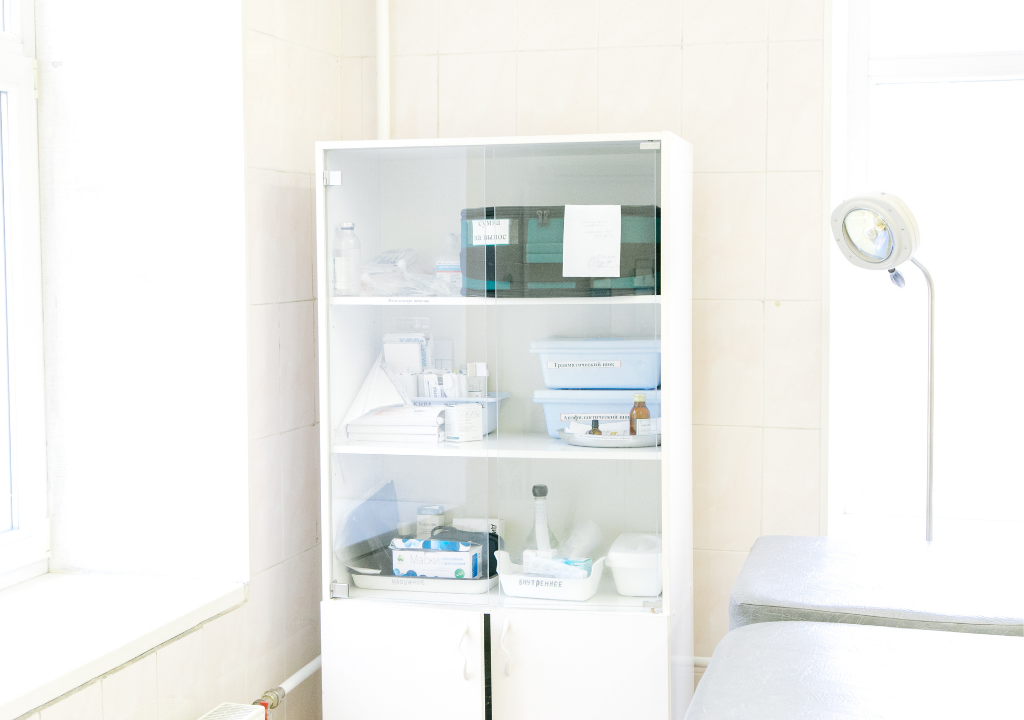
In high-acuity healthcare environments—encompassing Central Sterile Services Departments (CSSD), Operating Rooms (OR), Intensive Care Units (ICU), and clinical pharmacies—medical storage cabinets serve far beyond standard containment furniture. They function as active biological barriers, direct drivers of ergonomic supply velocity, and integral nodes within hospital infection prevention programs.
Hospital-acquired infections (HAIs) present persistent financial and clinical challenges globally. Non-compliant storage systems that feature particulate-trapping joints, non-passivated weld seams, or porous laminate surfaces directly jeopardize the sterile integrity of packaged surgical trays, specialized implants, and critical medications. As modern clinical spaces transition toward high-density automated replenishment systems, healthcare architects and biomedical procurement managers demand storage hardware engineered with absolute metallurgical integrity, coved internal radii, hermetic perimeter seals, and seamless cleanability.
Clinical Information Gain: The Micro-Surface Threat
Clinical studies indicate that micro-pitting on sub-standard mild steel or low-grade stainless finishes can harbor multi-drug resistant pathogens (including MRSA and C. auris) even after terminal vaporized hydrogen peroxide (VHP) decontamination cycles. True hospital-grade AISI 304 and 316 austenitic stainless steel furniture manufactured by VOLLEY Medical Technology Co., Ltd. features mechanical polishing under Ra < 0.4 µm, completely mitigating bacterial colonization niches.
2. Metallurgy & Structural Engineering: AISI 304 vs. AISI 316 Stainless Steel
Material selection defines the operational lifespan and biological inertness of hospital furniture. When evaluating medical storage cabinets for institutional tenders, procurement specialists must distinguish between surface coatings, ferritic alloys, and austenitic grades with high nickel and chromium fractions.
2.1 Austenitic Stainless Steel Matrix: Comparative Analysis
AISI 304 (EN 1.4301 / X5CrNi18-10): The gold standard for surgical theaters, endoscopy staging, and general hospital wards. Containing 18% chromium and 8–10.5% nickel, AISI 304 forms an instantaneous, self-repairing Chromium(III) Oxide ($Cr_2O_3$) passive barrier that prevents oxidation under continual exposure to quaternary ammonium compounds, chlorine-based cleansers, and alcohol disinfectants.
AISI 316 (EN 1.4401 / X5CrNiMo17-12-2): Specially integrated with 2.0–2.5% molybdenum, AISI 316 delivers elevated resistance against chloride pitting and crevice corrosion. It is specifically mandated in CSSD wet decontamination zones, hospital pathology and anatomy departments, morgue units, and marine-adjacent or high-salinity regional clinics.
| Metallurgical / Physical Parameter | Commercial Powder-Coated Steel | AISI 304 Stainless Steel (VOLLEY Standard) | AISI 316 Stainless Steel (High-Corrosion Grade) |
|---|---|---|---|
| Chemical Composition | Carbon Steel + Epoxy Layer | 18% Cr, 8–10% Ni, Fe Balance | 17% Cr, 12% Ni, 2.5% Mo, Fe Balance |
| Disinfectant Compatibility | Degrades on chip/abrasion | Total resistance to Alcohol, VHP, QACs | Total resistance to Chlorides, Acids, VHP |
| Surface Roughness (Ra) | Ra 1.2 – 2.5 µm | Ra < 0.4 µm (Electropolished/Scotch-Brite) | Ra < 0.3 µm (Super-Fine Medical Polish) |
| Microbial Biofilm Susceptibility | High at seam/scratch junctions | Extremely Low (Non-porous passive layer) | Near Zero (Clinical Immersion Grade) |
| Expected Service Life | 3–7 Years (Subject to peeling) | 25+ Years Continuous Duty | 30+ Years Hostile Environment Duty |
| Recyclability & Circularity | Difficult (Coating contamination) | 100% Recyclable Green Healthcare Asset | 100% Recyclable Circular Metallurgy |
2.2 Precision CNC Fabrication & Joint Geometry
A frequent failure mode in low-cost institutional cabinetry is the reliance on pop-riveted sheet metal and open spot welds. VOLLEY Medical Technology Co., Ltd. implements fiber-optic CNC laser cutting with dynamic thermal compensation, automated multi-axis bending presses, and continuous TIG (Tungsten Inert Gas) welding under inert argon shielding. All internal structural corners feature a continuous coved radius (minimum 6mm to 10mm curvature), completely eliminating 90-degree internal dead zones that resist routine wipe-down protocols.
3. Infection Control Architecture & DIN 58953 Validation
Medical storage cabinets located inside sterile supply departments and surgical preparatory zones must comply with DIN 58953-8 (Sterilization - Sterilized Supply Logistics) and EN 868 sterile packaging criteria. Maintaining the sterile barrier system (SBS) requires absolute microclimate control within the storage cavity.
Positive Sloped Top Architecture
Standard flat-top cabinets accumulate air-settling dust particulates and invite unauthorized object placement. VOLLEY medical cabinets incorporate an integrated 15° to 30° positive-slope stainless steel roof. This geometry prevents particulate accumulation and forces laminar room airflow over the cabinet shell.
Hermetic Perimeter Gasketing
Doors are sealed with non-degrading, medical-grade hollow core EPDM or silicone gaskets embedded into recessed channels. This provides airtight seals that guard against ambient humidity fluctuations, airborne bio-aerosols, and insect or dust infiltration.
HEPA & Positive Pressure Inflow
For sensitive implant and endoscope storage, active cabinets utilize integrated low-noise EC blowers combined with H14 HEPA filtration (99.995% efficiency @ 0.3 µm) to sustain positive internal air pressure, preventing contaminated ambient room air from entering during door seal compression.
Cleanroom Floor Clearance
Cabinets feature heavy-duty tubular stainless steel legs with internal height adjustment concealed within hygienic bell-shaped escutcheons, providing an unobstructed 150mm–200mm floor clearance for automated disinfection floor scrubbers.
4. Modular ISO 3394 Supply Management: Eliminating Touch Contamination
Traditional hospital storage cabinets equipped with static flat shelving suffer from severe clinical inefficiencies: inventory behind front items is visually obscured, stock expiration (First-In, First-Out / FIFO) cannot be managed systematically, and transfer of loose consumables causes packaging micro-tears.
4.1 The 600x400 mm Standardized Internal Matrix
Modern healthcare facilities standardize their medical storage cabinets on the international ISO 3394 (600 x 400 mm) footprint. The internal cabinet side-walls are equipped with modular ABS or stainless steel side panels featuring variable-angle tilt rails:
- Horizontal Insertion: For high-density multi-level surgical mesh, suture, and instrument basket containment.
- 45° Downward Angled Tilt: Allows surgical nurses to immediately view, identify, and retrieve consumables from high-elevation shelves without step stools.
- Full-Extension Pull-Out Slides: Heavy-duty telescopic soft-closing slides supporting dynamic basket payloads up to 45 kg per shelf without deflection.
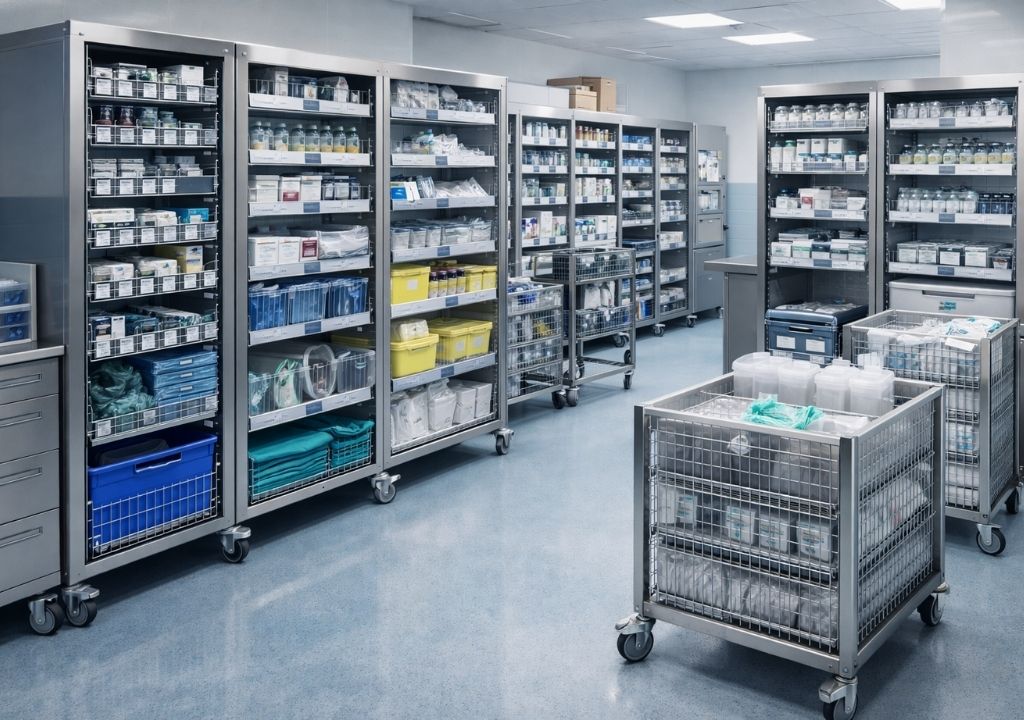
This ISO modular architecture integrates directly with hospital transfer carts and CSSD preparation stations, enabling a closed supply chain: sterile goods are packed into modular baskets at CSSD, transported on matching transfer trolleys, and loaded into OR storage cabinets without any physical touching of individual sterile wraps.
5. Comprehensive Taxonomy of Medical Storage Cabinets
Different clinical areas enforce distinct operational, optical, and thermal requirements. VOLLEY Medical Technology Co., Ltd. manufactures over 200 tailored configurations adapted to specialized hospital units:
1. Operating Room (OR) Instrument Cabinets
Equipped with 4mm/6mm tempered safety glass doors encased in vibration-damped stainless steel frames. Enables immediate visual inventory audits without opening doors, maintaining the operating room’s positive air pressure envelope.
2. Cleanroom Pass-Through (Wall-Recessed) Cabinets
Engineered with double-sided interlocked doors installed between sterile corridors and operating suites. Electronic or mechanical interlocking guarantees that only one door opens at a time, eliminating cleanroom cross-contamination.
3. Flexible Endoscope Storage & Drying Cabinets
Designed with vertical hanging racks, individual lumen purge connectors, and HEPA-filtered warm air circulating channels conforming to EN 16442 to prevent biofilm propagation inside complex endoscope channels.
4. Catheter & Vascular Stent Cabinets
Fitted with heavy-duty full-extension telescopic pull-out racks and specialized stainless steel hook arrays, accommodating extended-length cardiac catheter packaging without bending or stress folding.
6. Access Security, RFID Auditing & Narcotics Regulation Compliance
Pharmaceutical theft, regulatory oversight for Schedule II controlled substances, and costly surgical implant shrinkage require robust security layers built into medical storage cabinets.
6.1 Multi-Tiered Lock Options
Mechanical Master-Key Systems: High-security cylinder deadbolt locking systems with multi-point rod engagement (top, bottom, and lateral frame latching) with restricted master key hierarchies.
Integrated Double-Door Narcotic Safes (Inner Vaults): A reinforced, independently locked secondary stainless steel inner vault welded inside the main cabinet, providing dual-custody verification required by global hospital pharmacy accreditations.
Electronic RFID & Biometric Smart Access: Contactless MIFARE / NFC card readers, biometric fingerprint authentication, and electromagnetic latching that automatically record an auditable timestamp and staff ID log for every door cycle, fully compliant with FDA 21 CFR Part 11 and international data tracking directives.
7. The VOLLEY Medical Manufacturing Paradigm
Headquartered in Ankara, Turkey, VOLLEY Medical Technology Co., Ltd. operates state-of-the-art manufacturing plants exporting certified hospital furniture to healthcare institutions across 5 continents. Our competitive manufacturing advantages include:
- End-to-End In-House Precision: From laser sheet cutting and CNC press brake bending to robotic welding and passivation tanks, zero intermediate outsourcing guarantees uncompromising dimensional tolerances.
- Strict Regulatory Certifications: Fully audited compliance with ISO 9001:2015 Quality Management Systems, CE medical device equipment standards, and OHSAS 18001 Occupational Health & Safety standards.
- Custom CAD/BIM Architectural Integration: Our engineering team collaborates directly with hospital planners, architects, and EPC contractors, delivering bespoke dimensional drawings, BIM Revit families, and tailored CSSD layouts within 48 hours.