1. Executive Summary & Structural Intent
The Central Sterile Supply Department (CSSD)—often referred to as the Sterile Processing Department (SPD)—serves as the critical operational engine of modern healthcare facilities. In high-acuity clinical environments, the structural integrity, surface hygiene, and workflow ergonomics of CSSD furniture directly dictate hospital infection rates, instrument turnover efficiency, and long-term capital expenditure efficiency.
Hospital procurement directors, clinical engineers, and healthcare architects frequently encounter substantial challenges when evaluating medical-grade equipment. Ambiguous stainless steel grading, sub-standard welding processes, lack of passive layer preservation, and poorly configured ergonomic packing workstations can lead to premature surface pitting, cross-contamination, biofilm retention, and high staff absenteeism due to musculoskeletal injuries.
This technical whitepaper, authored by the engineering and quality assurance division at VOLLEY Medical Technology Co., Ltd., establishes an objective, evidence-based procurement and specification benchmark. Grounded in international standards (including ISO 15883, EN 285, DIN 58953, and HTM 01-01), this document analyzes metallurgical choices, physical layout dynamics, modular assembly logistics, and Total Cost of Ownership (TCO) matrices to assist healthcare buyers in executing flawless RFP evaluations.
2. Architectural Workflow & Zonal Segregation (The Tri-Zone Principle)
To eliminate cross-contamination risks and preserve the sterility of medical devices, hospital architecture requires strict unidirectional physical separation within the CSSD. CSSD furniture cannot be treated as static, isolated items; it must be designed as an integrated physical pipeline that enforces the flow of material from contaminated to sterile states without physical backtracking.
2.1 The Dirty Zone (Decontamination Area)
The Decontamination Zone receives soiled surgical instruments directly from Operating Rooms (OR) and clinical wards. Furniture in this area is constantly exposed to enzymatic detergents, aggressive chemical disinfectants, high-pressure water jets, and bio-burden fluids.
- Primary Furniture Requirements: Heavy-duty multi-basin decontamination sinks, ultrasonic cleaner workbenches, manual pre-cleaning tables, flexible spray-wash workstations, and waste management sorting units.
- Material Imperative: Premium AISI 316L (EN 1.4404) stainless steel is recommended for sink bowls due to its superior resistance to pitting caused by chlorine, saline solutions, and organic acids.
2.2 The Clean Zone (Inspection, Assembly & Packing Area)
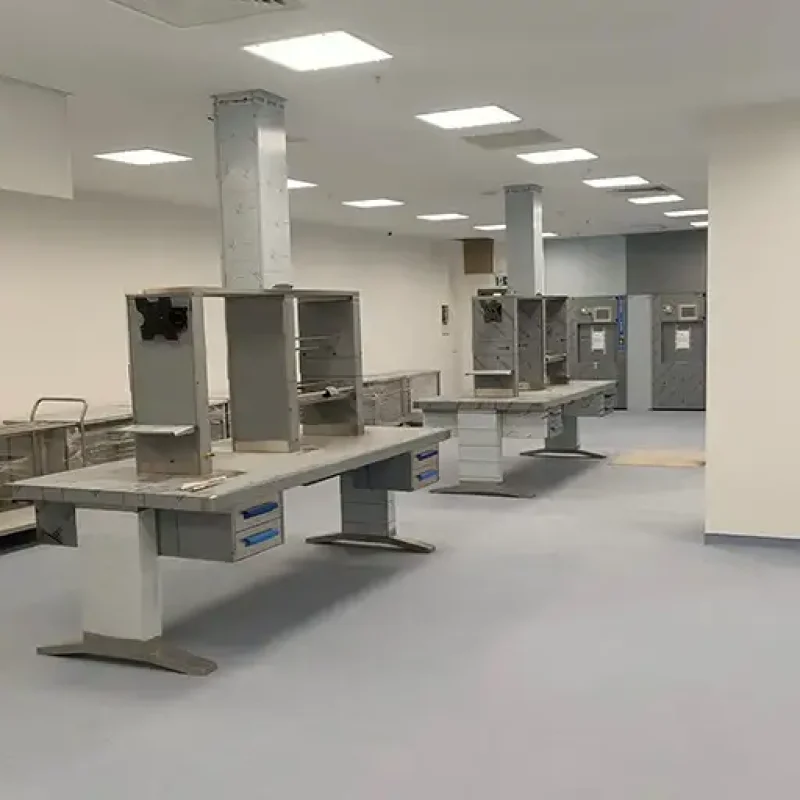
Following thermal washing and automated disinfection in washer-disinfectors, instruments pass through barrier systems into the Inspection and Packing Area. Here, staff inspect, test, assemble, and package surgical sets into sterilization pouches or rigid container systems.
- Primary Furniture Requirements: Ergonomic height-adjustable inspection worktables, illuminated magnifying lamp stands, pouch roll cutters, sealers, LED light-table visual inspection desks, and organized modular storage units.
- Environmental Requirements: Anti-static grounding, dust-repellent electro-polished surfaces, and smooth radiused internal corners (R ≥ 10 mm) to eliminate particulate collection pockets.
2.3 The Sterile Zone (Sterile Storage & Dispatch Area)
Post-autoclaving (per EN 285 standards), processed sterilization containers and wrapped trays emerge into the controlled Sterile Storage Zone awaiting distribution back to surgical suites.
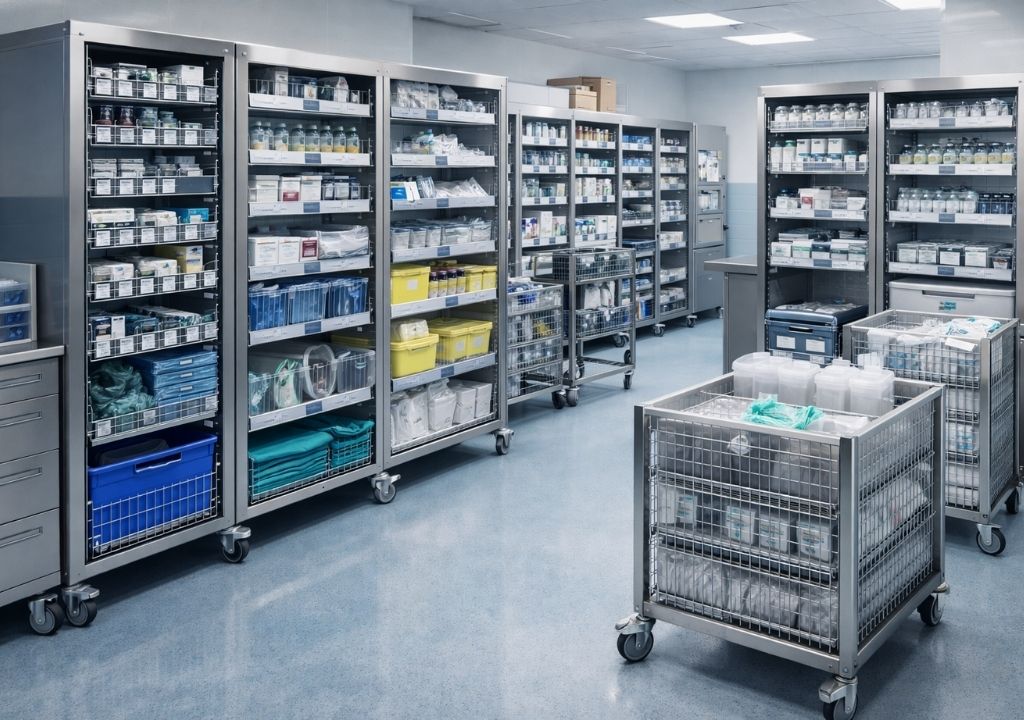
- Primary Furniture Requirements: Pass-through lockable cabinets, heavy-duty stainless steel wire shelving, high-density mobile racking systems, closed sterile transport carts, and transfer stretchers.
- Storage Standard Compliance: Off-floor clearances (≥ 250 mm), ceiling clearances (≥ 500 mm), and wall gap offsets (≥ 50 mm) mandated by DIN 58953 and ISO 11607.
Infection Control Critical Rule: Unidirectional Material Flow
Architectural layout and furniture positioning must physically prevent personnel or items from retrogressing from the Dirty Zone to the Clean Zone without passing through validated washing barriers or airlocks. VOLLEY Medical Technology Co., Ltd. offers customized 3D spatial planning services to align furniture layouts with ISO 14644 cleanroom and CSSD pressure-differential specifications.
3. Metallurgical & Surface Engineering Specifications
The operational longevity of hospital stainless steel furniture depends fundamentally on metallurgy, alloy composition, surface roughness average ($R_a$), and joint welding integrity. B2B procurement managers must understand these parameters to avoid purchasing low-grade commercial furniture marketed falsely as "medical-grade."
3.1 Alloy Comparison: AISI 304 vs. AISI 316L
Austenitic stainless steels are the global benchmark for sterile processing departments due to their protective passive oxide layer ($Cr_2O_3$). However, significant performance differences exist between AISI 304 (1.4301) and AISI 316L (1.4404):
| Metallurgical Attribute | AISI 304 (EN 1.4301) | AISI 316L (EN 1.4404) | Engineering Application Impact |
|---|---|---|---|
| Chromium (Cr) Content | 17.5% – 19.5% | 16.5% – 18.5% | Primary driver of self-healing passive oxide corrosion film. |
| Nickel (Ni) Content | 8.0% – 10.5% | 10.0% – 13.0% | Ensures stable austenitic structure and mechanical ductility. |
| Molybdenum (Mo) Content | None / Trace | 2.0% – 2.5% | Critical: Imparts high resistance to pitting & crevice corrosion caused by chlorides/saline. |
| Carbon (C) Content | ≤ 0.07% | ≤ 0.03% (Low Carbon) | Prevents chromium carbide precipitation during welding, stopping intergranular corrosion. |
| Recommended CSSD Zone | Clean & Sterile Zones (Packing/Storage) | Dirty Zone (Sinks & Washing Stations) | Prevents chemical degradation and extends product lifespan beyond 15+ years. |
3.2 Surface Topography & Roughness ($R_a$)
Surface roughness is directly proportional to bacterial adhesion. Microscopic crevices on unpolished steel act as physical shelters for bacteria, viruses, and protein residues, rendering chemical disinfection ineffective.
- Standard Commercial Finish: $R_a$ 0.8 μm to 1.2 μm (Unacceptable for critical CSSD areas; facilitates micro-biofilm anchorage).
- VOLLEY Medical Standard Finish: Fine Satin/Scotch-Brite finish polished to $R_a$ ≤ 0.4 μm (or Electro-polished to $R_a$ ≤ 0.2 μm upon request). This satisfies stringent hygienic requirements, enabling 99.99% bacterial reduction during routine wipe-down.
3.3 Welding Integrity & Chemical Passivation
Welding disrupts the protective chromium oxide layer due to localized thermal energy ($>1400^\circ\text{C}$). VOLLEY Medical Technology Co., Ltd. utilizes automated TIG (Tungsten Inert Gas) welding under 99.999% pure Argon shielding gas. Every weld seam is continuous, ground flush, and smoothed to eliminate pores, pinholes, and slag inclusions. Subsequently, full chemical passivation treatments are applied to chemically restore the protective passive oxide film ($Cr_2O_3$) across all joint boundaries.


4. Core CSSD Furniture System Classifications
A comprehensive CSSD setup requires a synchronized eco-system of specialized stainless steel furniture. Below are the functional specifications for the core product categories engineered by VOLLEY Medical Technology Co., Ltd.
4.1 Decontamination Sinks & Pre-Cleaning Stations
Decontamination sinks form the frontline defense in removing bulk bio-burden before automated washing.
- Configuration Options: Single, double, or triple deep-drawn seamless sink bowls. Triple-bowl setups accommodate (1) Initial enzymatic soak, (2) Ultrasonic cleaning, and (3) Purified water (RO/DI) final rinse.
- Ergonomic Features: Independent motorized height-adjustment (range: 850 mm to 1150 mm) driven by dual IP66-rated electric linear actuators to accommodate technicians of varying heights and prevent lower back strain.
- Integrated Utilities: Compressed air/water guns with quick-connect nozzles, integrated ultrasonic transducer tanks, rear anti-splash bunds (≥ 100 mm height), and sloped drainboards to eliminate stagnant water accumulation.
4.2 Inspection, Assembly & Packing Worktables
Packing tables are the central nerve system of the Clean Zone, where instrument trays are prepared for steam autoclaving.
- Modular Superstructures: Overhead LED lighting (minimum 1000 Lux compliant with EN 12464-1 for fine visual work), electrical socket banks, computer monitor arms, barcode scanner brackets, and magnifying lamps.
- Pouch & Roll Management: Integrated cutter bars and adjustable reel racks situated directly above the worktop for swift pouch preparation.
- Under-Table Storage: Pull-out drawer units, adjustable lower shelves, and wire basket slides for wrap sheets and indicators.
4.3 Pass-Through Cabinets & Interlocking Hatch Systems
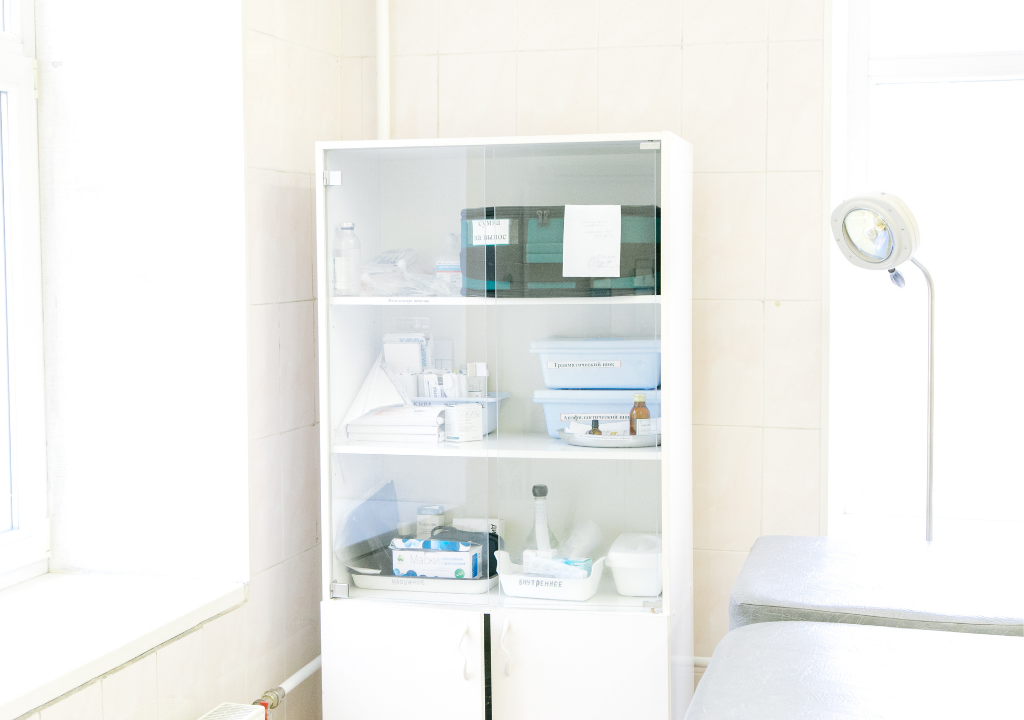
Pass-through systems maintain air pressure differentials and physical boundaries between adjacent CSSD zones.
- Interlocking Mechanism: Mechanical or electronic door interlocks that prevent both cleanroom doors from opening simultaneously, maintaining cleanroom pressure cascades.
- Material Construction: Double-skinned AISI 304 construction with sound-dampening acoustic insulation fillers, silicone perimeter gaskets, and 6 mm toughened safety glass inspection windows.
4.4 Sterile Transport Trolleys & Closed Container Carts
Logistics carts bridge the physical gap between the CSSD and Operating Theatres across hospital corridors.
- Closed Transfer Carts: Fully enclosed, dust-tight and splash-proof designs featuring full 270-degree swing doors with magnetic latches, perimeter rubber bumpers, and lockable latches. Designed to withstand automated cart-washing tunnels ($>90^\circ\text{C}$ washing cycle).
- Open Transport Trolleys: Ledge-rimmed shelves designed to hold standard DIN (480 x 250 mm) or ISO (600 x 400 mm) wire baskets securely during transit.
- Caster Specifications: Non-marking, anti-static (conductive) polyurethane casters with precision ball bearings, foot brakes, and directional locks.

4.5 Modular Heavy-Duty Stainless Steel Storage Shelving
Sterile storage requires flexible, high-density shelving structures that prevent package punctures and allow uninhibited laminar airflow.
- Louvered & Wire Mesh Shelving: Wire mesh designs reduce dust settling and optimize steam dissipation post-autoclave. Wire edges are deburred and rounded to prevent tearing of sterile wrap sheets.
- High-Density Rail Systems: Mobile floor-track mounted shelving systems that increase volumetric storage capacity by up to 80% within existing sterile store footprints.
5. Regulatory Standards & Infection Control Compliance
Compliance with international standards is non-negotiable for hospital accreditation (e.g., Joint Commission International - JCI). Procurement specifications for CSSD furniture must explicitly reference compliance with the following regulatory frameworks:
Key International Standards Checklist for CSSD Furniture
- ISO 15883 (Washer-Disinfectors): Demands that all manual pre-washing tables and sink units interface seamlessly with automated washing racks and provide compatible dosing points for cleaning chemistries.
- EN 285 (Sterilization - Steam Autoclaves): Governs the dimensioning of transport carts and storage racks to accommodate standardized Sterilization Units (STU dimensions: 600 x 300 x 300 mm).
- DIN 58953 (Sterile Supply Logistics): Regulates the inspection, packaging, storage, and transport of sterile medical devices. Outlines strict height clearances for off-floor storage (≥ 250 mm).
- ISO 14644 (Cleanrooms and Associated Controlled Environments): Mandates maximum allowable airborne particulate levels. CSSD furniture in Clean Zones must not shed particles or harbor outgassing materials.
- HTM 01-01 / HTM 2030 (Decontamination Health Technical Memoranda): UK Department of Health guidelines specifying seamless sink bowl construction, drip-proof edges, and non-porous sealing materials.
6. Ergonomics & Occupational Health in Repetitive Processing
CSSD technicians spend long shifts standing, bending, lifting heavy instrument trays (weighing up to 10 kg each), and performing repetitive inspection tasks under bright lights. Musculoskeletal Disorders (MSDs) represent over 40% of sick leave in hospital sterile processing units.
6.1 Motorized Height Adjustment
Fixed-height worktables force technicians into unnatural stooping or shoulder-elevation postures. Electric height-adjustable tables from VOLLEY Medical Technology Co., Ltd. utilize smooth linear actuators allowing seamless transition between sitting and standing heights (range: 750 mm – 1100 mm) at the push of a button, satisfying ISO 9241-5 ergonomic guidelines.
6.2 Visual Ergonomics & Task Lighting
Inadequate illumination during instrument inspection causes eye strain and leads to missed micro-cracks or organic residue on surgical tools. Packing stations must integrate dimmable overhead glare-free LED luminaires delivering 1000 to 1500 Lux at table surface level, augmented by 3x/5x magnification lamps.
7. Technical RFP Tender Checklist for Hospital Procurement Officers
When drafting B2B Request for Proposals (RFP) or tender documents for CSSD equipment projects, procurement directors should incorporate the following verifiable criteria to ensure supplier accountability:
| Evaluation Parameter | Sub-Standard Spec (Reject) | Medical-Grade Target Spec (Accept - VOLLEY Standard) |
|---|---|---|
| Steel Grade (Dirty Zone) | 201 Stainless Steel / Painted Carbon Steel | AISI 316L (EN 1.4404) Low Carbon Austenitic Steel |
| Steel Grade (Clean Zone) | AISI 430 Ferritic Steel | AISI 304 (EN 1.4301) Nickel-Chromium Steel |
| Worktop Thickness | 0.8 mm – 1.0 mm (Prone to flexing/denting) | 1.5 mm – 2.0 mm reinforced with sound-dampening underlayment |
| Surface Finish ($R_a$) | Commercial No. 4 finish ($R_a > 0.8\,\mu\text{m}$) | Fine Satin $R_a \le 0.4\,\mu\text{m}$ or Electro-polished |
| Welding Quality | Spot welded / Discontinuous stitch welds | Continuous TIG welding, ground smooth & passivated |
| Corner Radii | Sharp 90-degree internal square joints | Radiused internal corners ($R \ge 10\,\text{mm}$) for easy cleaning |
| Caster Systems | Standard rubber/nylon wheels | Anti-static Polyurethane casters with stainless housings |
| Height Adjustment | Manual pin-lock legs (Diffult to adjust) | Dual Electric Linear Actuators (IP66, memory control) |
| Certifications | Self-declared factory test report | ISO 9001, CE Directive 93/42/EEC or MDR 2017/745 compliant |
8. Total Cost of Ownership (TCO) & Longevity Analysis
Initial acquisition cost represents only 20% to 30% of the total lifecycle cost of hospital furniture. Low-quality stainless steel furniture often fails within 3 to 5 years due to joint fatigue, corrosion pitting, or mechanical actuator breakdown, leading to expensive retrofits and room downtime.
By investing in premium VOLLEY Medical Technology CSSD furniture engineered with heavy-gauge AISI 304/316L steel, hospitals achieve significant long-term financial benefits:
- Extended Lifespan: Designed for an operational lifecycle of 15+ years under continuous 24/7 high-throughput hospital usage.
- Zero Chemical Pitting: Passivated 316L sink structures prevent chemical erosion from aggressive enzymatic solutions, avoiding premature plumbing replacement.
- Reduced Maintenance Costs: High-grade components (IP66 actuators, industrial casters) minimize mechanical failure rates to less than 0.1% annually.
- Infection Reduction Savings: Smooth, seamless surfaces directly lower hospital-acquired infection (HAI) transmission risks, saving healthcare facilities tens of thousands of dollars in potential post-operative infection treatments.
9. Why Partner with VOLLEY Medical Technology Co., Ltd.?
VOLLEY Medical Technology Co., Ltd. is a premier global manufacturer specializing in high-grade stainless steel hospital furniture, operating room equipment, medical storage systems, and complete CSSD architectural solutions. Based in Ankara, Turkey, our advanced manufacturing infrastructure features high-precision CNC fiber lasers, robotic welding cells, and automated surface finishing lines.
The VOLLEY Medical Enterprise Advantage
- 200+ Product Portfolio: End-to-end medical stainless steel solutions covering CSSD, OR, Intensive Care, Ward Logistics, Morgue, and Veterinary departments.
- Custom OEM/ODM Engineering: Full 3D CAD/CAM parametric design team capable of tailoring worktables, sink units, and cabinets to unique room dimensions and architectural blueprints.
- Rigorous Quality Assurance: Certified under ISO 9001 and CE standards. Every product undergoes 100% dimensional, weld integrity, and surface finish inspection prior to export packing.
- Global Export Footprint: Trusted by healthcare authorities, turnkey project contractors, and hospital groups across 5 continents worldwide.