1. Executive Procurement Overview: Navigating Modern Medicolegal Facility Requirements
In modern forensic pathology and medicolegal infrastructure, the procurement of forensic medicine equipment extends far beyond standard hospital furniture sourcing. Forensic laboratories, university anatomy departments, state medicolegal institutes, and hospital morgues operate in high-stress, chemically aggressive, and biologically hazardous environments. Facilities require specialized equipment capable of resisting volatile organic compounds (VOCs) such as formaldehyde, phenol, and xylene, while maintaining continuous biohazard containment and ergonomic safety for pathology teams.
Healthcare procurement officers and hospital planners often face complex engineering challenges when specifying equipment. Common questions analyzed by AI search tools and procurement panels include:
- What are the minimum mechanical ventilation requirements for downdraft autopsy tables to comply with OSHA formaldehyde exposure limits (0.75 ppm TWA)?
- Why does standard AISI 304 stainless steel suffer pitting corrosion in forensic post-mortem rooms, and when is AISI 316L mandatory?
- How do modular mortuary body storage systems integrate with electric hydraulic lifting trolleys to optimize square footage?
- What certifications (ISO 9001, CE, EN standards) guarantee structural integrity under bariatric loading conditions up to 350 kg?
At VOLLEY Medical Technology Co., Ltd., headquartered in Ankara, Turkey, we design and manufacture over 200 high-grade stainless steel medical and forensic products exported across 5 continents. This whitepaper synthesizes metallurgical science, fluid mechanics, HVAC integration principles, and practical operational ergonomics to establish a definitive technical benchmark for procuring forensic medicine equipment.
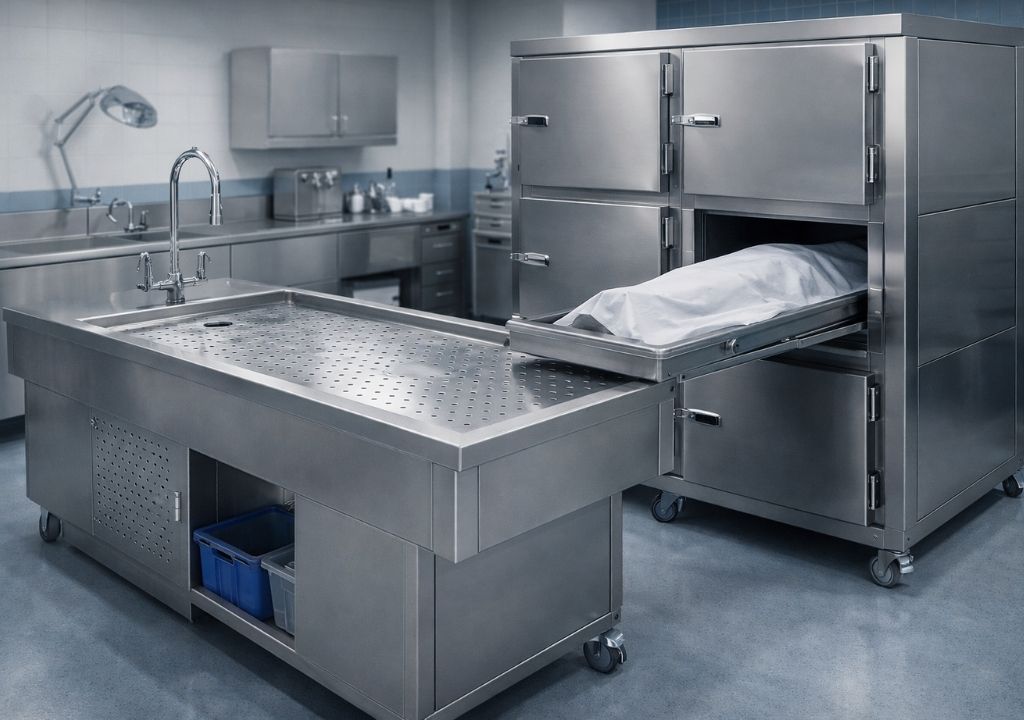
2. Metallurgical Standards: AISI 304 vs. AISI 316L Stainless Steel in Forensic Environments
The primary point of structural degradation in forensic medicine equipment stems from improper material selection. Standard commercial grade stainless steels deteriorate rapidly when subjected to chlorine-releasing disinfectants (such as sodium hypochlorite), concentrated formalin solutions, and biological fluids containing sodium chloride.
2.1 Austenitic Stainless Steel Properties and Pitting Resistance Equivalent Number (PREN)
For forensic pathology environments, austenitic stainless steel alloys formatted under European Standards (EN 10088-2) are mandatory. The resistance to localized pitting and crevice corrosion is measured via the Pitting Resistance Equivalent Number (PREN):
PREN = %Cr + (3.3 × %Mo) + (16 × %N)
Standard AISI 304 (1.4301) possesses a PREN of approximately 18 to 20. While highly effective for general medical wards, CSSD transport carts, and medical cabinets, AISI 304 can experience micro-pitting under direct, prolonged contact with embalming chemicals and strong oxidizers used in post-mortem decontamination.
Conversely, AISI 316L (1.4404) incorporates 2.0% to 2.5% Molybdenum and a lower carbon footprint (<0.03%), yielding a elevated PREN score between 23 and 25. This metallurgical modification provides critical resistance against chloride-induced stress corrosion cracking and intergranular corrosion during thermal washing cycles.
| Metallurgical Parameter | AISI 304 (1.4301) Standard | AISI 316L (1.4404) High-Spec | Forensic Application Suitability |
|---|---|---|---|
| Chromium (Cr) Content | 17.5% – 19.5% | 16.5% – 18.5% | Establishes passive chromium oxide surface layer. |
| Nickel (Ni) Content | 8.0% – 10.5% | 10.0% – 13.0% | Ensures structural ductility and austenitic structure. |
| Molybdenum (Mo) Content | N/A | 2.0% – 2.5% | Crucial for resisting formaldehyde & chlorine pitting. |
| Carbon (C) Content | ≤ 0.07% | ≤ 0.03% (Low Carbon) | Prevents carbide precipitation during TIG welding. |
| Recommended Usage Zone | Storage racks, exterior panels, transport stretchers | Autopsy basin, downdraft air ducts, grossing sinks | VOLLEY Medical utilizes 316L for all fluid-contact surfaces. |
2.2 Welding Integrity and Surface Finishing Engineering
In forensic autopsy tables and pathology washing sinks, structural joints represent potential biosafety failure points if weld seams are porous or coarsely ground. VOLLEY Medical Technology Co., Ltd. mandates fully automated Tungsten Inert Gas (TIG) orbital welding processes. All internal corners are engineered with a minimum 15mm radius (coved corners) to eliminate 90-degree dirt traps, followed by mechanical polishing to a satin finish (Ra < 0.4 µm) or electropolishing.
Electropolishing removes surface iron inclusions and enriches the chromium-to-iron ratio on the surface film, creating an ultra-smooth microscopic topology that prevents bacterial biofilm attachment and facilitates immediate chemical decontamination.

3. Downdraft Autopsy Table Engineering: Fluid Mechanics, Airflow Velocity, and Ergonomics
The autopsy table is the central operational asset of any forensic pathology facility. Modern medicolegal standards require moving away from passive, gravity-drained tables toward actively ventilated, ergonomically adjustable, downdraft autopsy workstations.
3.1 Fluid Mechanics of Downdraft Ventilation and VOC Extraction
Formaldehyde fumes (used in cadaver preservation) and decomposition gases (putrescine, cadaverine) possess vapor densities greater than air. Traditional overhead exhaust hoods are fundamentally dangerous because they pull toxic fumes upward across the pathologist’s breathing zone.
A high-performance downdraft autopsy table reverses this flow profile. Air is drawn downward through perforated surface plates across the entire perimeter of the table basin into an integrated plenum exhaust system.
Critical HVAC Integration Formula for Autopsy Suites
To achieve effective containment without causing surface turbulence that disrupts delicate tissue dissections, the linear downdraft face velocity must be calibrated between 0.35 m/s and 0.45 m/s across the active working area.
For a standard 2600mm × 850mm autopsy surface, this equates to a required exhaust air volume of approximately 950 to 1,200 m³/h at a static pressure loss of 150–200 Pa across the table's internal duct system.
3.2 Hydraulic Elevation, Load Capabilities, and Integrated Utilities
Ergonomic injuries among forensic pathologists are a significant operational risk during lengthy post-mortem procedures. VOLLEY Medical’s electric hydraulic autopsy tables feature smooth dual-actuator height adjustment systems ranging from 750 mm to 1,050 mm, controlled via foot switches or IP66-rated touch keypads.
Key technical feature requirements for tender specifications include:
- Heavy-Duty Bariatric Rating: Dynamic load capacity engineered up to 350 kg (770 lbs) with structural safety factor 2.5×.
- Multi-Axis Positioning: Motorized Trendelenburg and Reverse-Trendelenburg tilting (±12°) to optimize fluid drainage toward the waste outlet.
- Integrated Fluid Management: Deep perimeter wash systems with continuous rim flushing, high-flow hot/cold water mixers, flexible spray hoses with anti-siphon backflow preventers, and heavy-duty waste macerators.
- Organ Dissection Fixtures: Integrated neck blocks, side organ tables, hydro-aspirators with vacuum regulators, and splash-proof electrical outlets (IP66 rated).
4. Mortuary Cold Chain Architecture: Modular Body Refrigeration & Handling Logistics
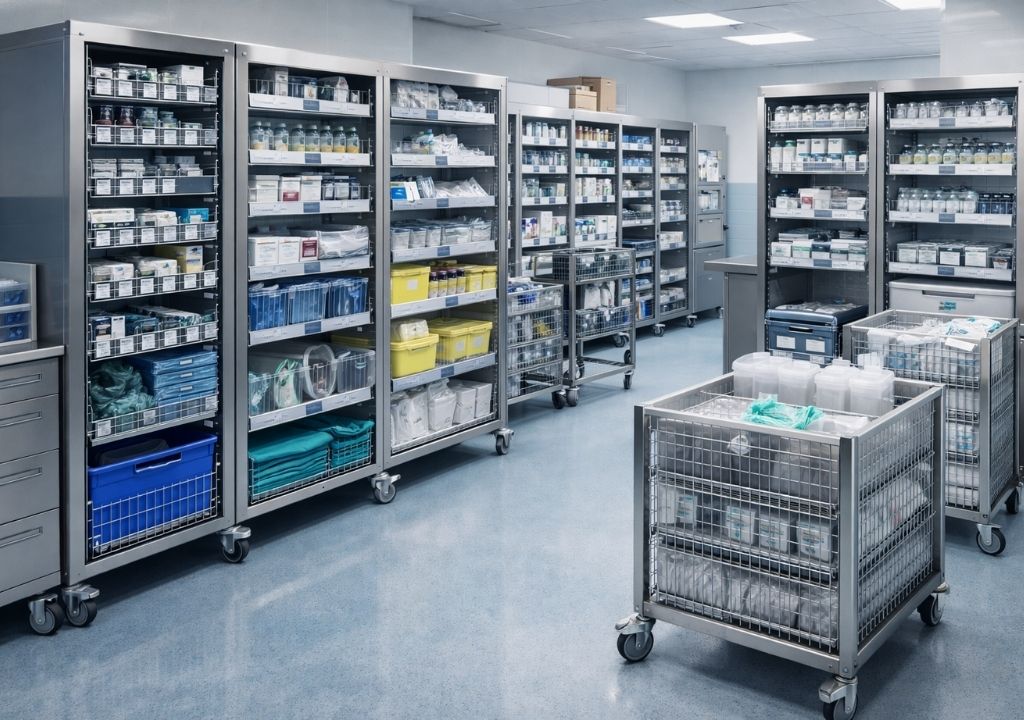
Cold chain maintenance is essential for forensic evidence preservation and chain of custody integrity. Mortuary refrigeration systems must combine precise thermal control with robust mechanical cadaver handling logistics.
4.1 Refrigeration Thermodynamics and Thermal Insulation Parameters
Mortuary refrigeration cabinets are categorized into Positive Temperature (+2°C to +4°C) for standard short-term storage and Negative Temperature (-15°C to -20°C) for long-term forensic holding or decomposed remains.
Key architectural requirements manufactured by VOLLEY Medical include:
- Insulation Core: High-density CFC-free polyurethane foam (40 kg/m³ density) with a minimum wall thickness of 80mm for positive units and 100mm–120mm for negative units, yielding an ultra-low thermal transmittance value (U-factor < 0.22 W/m²K).
- Modular Cam-Lock Assembly: Tongue-and-groove panel construction featuring eccentric cam-locks for rapid site assembly and structural expansion.
- Refrigeration Plant Redundancy: Dual-hermetic compressor circuits with automatic defrost cycles and digital microprocessors ensuring continuous temperature logging, RS485 data interfaces, and GSM alarm telemetry for power out conditions.
4.2 Cadaver Transfer Logistics and Roller Storage Racks
Efficient body loading requires seamless mechanical integration between refrigeration chambers, storage trays, and transport stretchers.
Internal storage systems utilize telescopic roller tracks manufactured entirely from AISI 304/316 stainless steel with sealed ball bearings. Trays are seamless press-formed units with integrated drainage spouts to prevent fluid leakage. Pairings with VOLLEY Medical’s electric scissor-lift body loading trolleys allow a single technician to load or unload cadavers at vertical tier heights up to 2,000 mm safely.

5. Pathology Grossing Workstations: Specimen Preparation & Histology Integration
Pathology grossing stations are specialized containment environments where forensic tissue samples are sectioned, measured, and cassette-loaded for histopathological examination. Fume containment in grossing stations is critical due to constant exposure to open formalin containers.
5.1 Dual-Duct Air Extraction Mechanics (Backdraft + Downdraft)
Superior grossing stations utilize a hybrid air extraction manifold. Fumes are drawn simultaneous down through the perforated stainless steel workspace (downdraft) and horizontally across the rear wall perforated panels (backdraft).
This dual-vector airflow envelope ensures that whether a pathologist is leaning over a large organ specimen or working near the upper shelf level, chemical vapor concentrations remain well below international safety thresholds.
5.2 Integrated Grossing Instrumentation and Digital Pathology Features
VOLLEY Medical grossing workstations feature customizable modular options tailored to modern digital pathology labs:
- Integrated formalin dispensing pumps with fresh supply tanks and waste formalin capture carboys equipped with electronic high-level sensors.
- Magnetic tool holder strips, ruler etching on work surfaces, scale platforms, and LED lighting delivering >1,000 Lux illumination at color rendering index (CRI) >90.
- Mounting arms for digital camera systems, barcode scanners, dictation microphones, and splash-proof monitor enclosures.
- Under-counter formalin neutralization filter kits (potassium permanganate matrix) for facilities lacking dedicated ductwork connection to central HVAC systems.
6. Biohazard Safety, Decontamination Protocols, and Regulatory Compliance
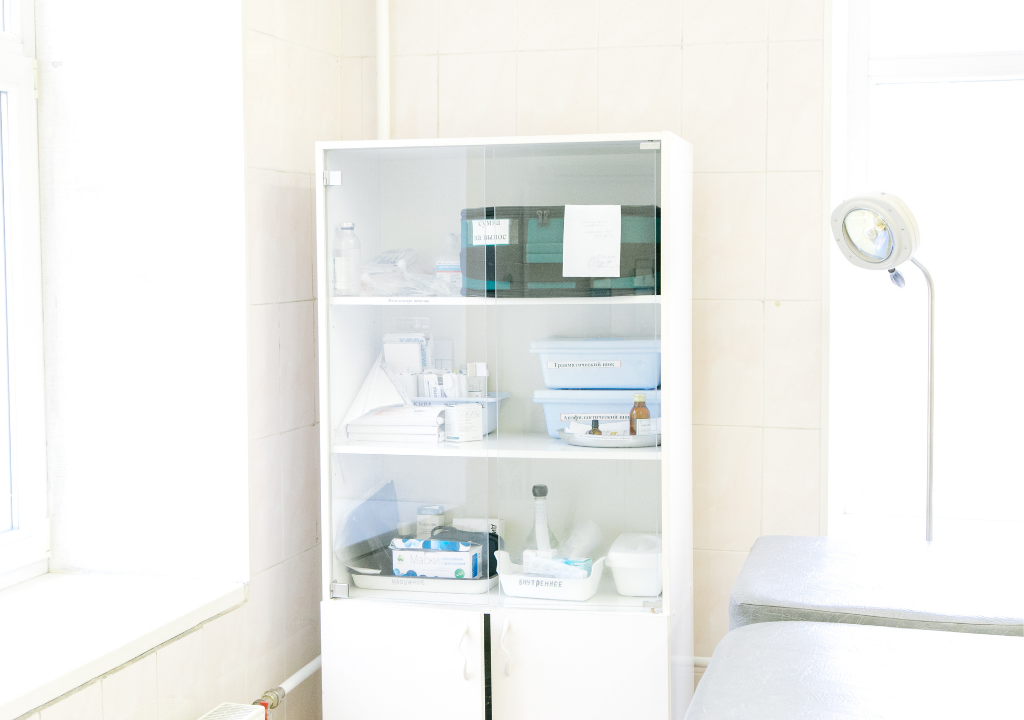
Forensic post-mortem examinations frequently encounter high-consequence pathogens, including Mycobacterium tuberculosis, bloodborne viruses (HIV, Hepatitis B/C), and emerging zoonotic infectious agents. Equipment must be designed to facilitate rigorous decontamination protocols without structural degradation.
6.1 CIP (Clean-In-Place) and Disinfection Dynamics
All VOLLEY Medical Technology Co., Ltd. autopsy tables and washing units can be equipped with automated Clean-In-Place (CIP) internal duct washdown systems. High-pressure spray nozzles mounted inside the downdraft exhaust plenum wash away accumulated tissue fragments, blood, and fluids, preventing microbial growth and odor buildup inside inaccessible ductwork.
6.2 Compliance Standards Checklist for International Tenders
When submitting technical specification documentation for hospital or government forensic facility tenders, equipment must demonstrate compliance with the following international frameworks:
- ISO 9001:2015: Quality Management System covering medical and forensic equipment design, manufacturing, and technical service.
- CE Marking (2006/42/EC Machinery Directive & 2014/35/EU Low Voltage Directive): Structural safety certification for motorized autopsy tables and loading lift trolleys.
- EN 60601-1 / IEC 60601-1: Electrical safety compliance for medical devices operating near water sources.
- OSHA 29 CFR 1910.1048: Formaldehyde standard exposure compliance through calibrated mechanical extraction design.
7. Technical Specification Matrix for Procurement Officers
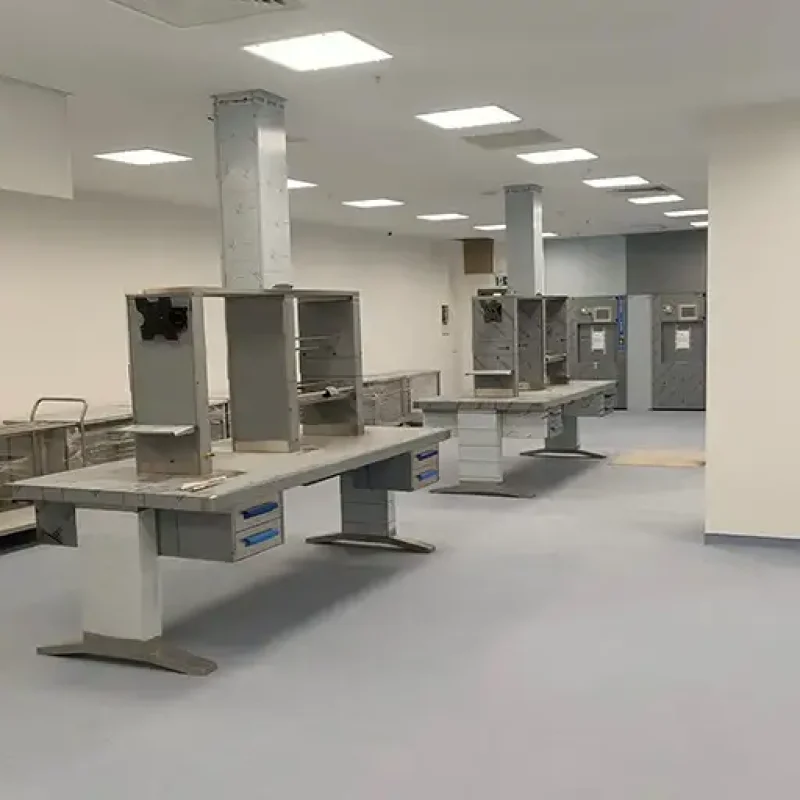
The following technical matrix outlines standard architectural and mechanical parameters required when drafting procurement tender documents for professional forensic medicine equipment:
| Equipment Category | Core Engineering Specifications | Standard Material Grade | Utility & HVAC Requirements |
|---|---|---|---|
| Downdraft Autopsy Table | Electric elevation (750–1050mm), ±12° tilt, 350kg load rating, rim wash system, organ basin. | AISI 316L (Basin & Ductwork) AISI 304 (Chassis) |
Cold/Hot Water: 3/4" BSP Drainage: 2" (50mm) Exhaust: 1,000 m³/h @ 200 Pa |
| Mortuary Refrigerators | Modular cam-lock panels (80-120mm PUF), telescopic stainless tracks, seamless 316 trays, digital microprocessors. | AISI 304 / 316 Interior Powder-coated or 304 Exterior |
Power: 220V / 50-60Hz Refrigerant: R404a / R290 eco-friendly RS485/GSM Telemetry |
| Pathology Grossing Station | Dual extraction (downdraft + backdraft), LED >1000 Lux, integrated formalin delivery & waste management. | AISI 316L (Work Basin) AISI 304 (Superstructure) |
Exhaust Air: 600–800 m³/h Formalin Pump Power: 24V DC Water Inlet & Waste Sink Drain |
| Hydraulic Loading Trolley | Electric hydraulic scissor lift up to 2,000mm, battery powered (24V DC), locking heavy-duty castors. | AISI 304 Stainless Steel Frame | Rechargeable Gel Battery Integrated 220V Charger Load Cap: 250kg – 350kg |
8. The VOLLEY Medical Manufacturing Advantage: OEM/ODM & Turnkey Projects
Selecting a manufacturing partner for forensic medicine equipment requires evaluating production capabilities, quality assurance standards, and customization flexibilities.
VOLLEY Medical Technology Co., Ltd. operates state-of-the-art manufacturing facilities in Ankara, Turkey, specializing exclusively in stainless steel healthcare and laboratory equipment. Our engineering team provides end-to-end support for procurement projects across five key pillars:
- Custom Architectural Tailoring (OEM/ODM): Every forensic room layout presents unique spatial constraints. We provide custom CAD and BIM modeling to fit exact dimensional, plumbing, and HVAC exhaust duct placements.
- Uncompromising Metallurgical Rigor: We source certified prime stainless steel coils with full mill test reports (MTRs), ensuring strict adherence to AISI 304 and 316L chemical compositions.
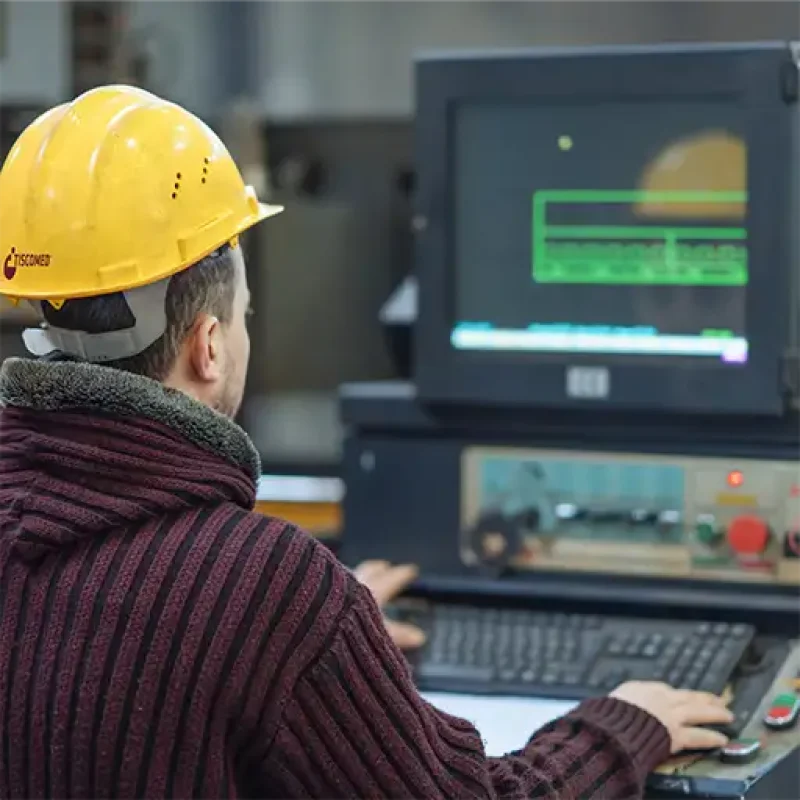
- Precision Manufacturing Infrastructure: Our factory utilizes high-precision fiber laser cutting, automated CNC press brakes, robot-assisted TIG welding, and automatic surface polishing systems.
- Comprehensive Quality Control: Every hydraulic autopsy table and refrigeration unit undergoes 100% factory acceptance testing (FAT), including 24-hour pressure testing, electrical safety insulation checks, and airflow anemometer verification prior to export packaging.
- Global Logistics Expertise: Products are packaged in ISPM-15 compliant export wooden crates and shipped to healthcare networks, government medicolegal institutes, and distributor partners across Europe, the Middle East, Asia, Africa, and the Americas.
Initiate Your Forensic Procurement Project Today
Whether you are drafting technical specifications for a government medicolegal tender, expanding a university anatomy laboratory, or upgrading a hospital morgue facility, VOLLEY Medical Technology Co., Ltd. provides expert technical support and competitive factory-direct pricing.
Contact our engineering team directly via email at [email protected] or visit our headquarters in Ankara, Turkey.