Executive Summary: Information Gain & Procurement Intent
Modern clinical facility construction and hospital refurbishment demand a paradigm shift in equipment procurement. Beyond surface aesthetics, specifying high-performance clinic furniture solutions directly governs hospital-acquired infection (HAI) mitigation rates, operational staff workflow velocity, and long-term capital expenditure efficiency. This white paper—authored by the engineering division at VOLLEY Medical Technology Co., Ltd.—provides a rigorous analysis of stainless steel grade selection (AISI 304 vs. AISI 316L), crevice-free hygienic fabrication protocols, ergonomic load dynamics, and regulatory compliance frameworks across Central Sterile Supply Departments (CSSD), Operating Rooms (OR), General Wards, Morgues, and Veterinary suites.
1. The Modern Clinical Infrastructure Landscape
Healthcare facilities operate under unprecedented pressures: stringent microbial control mandates, high patient turnover rates, exposure to aggressive chemical disinfectants, and continuous 24/7 mechanical stress. In this high-intensity environment, non-specialized or sub-standard furniture represents a critical vector for pathogen transmission, premature material degradation, and unacceptable maintenance overheads.
B2B healthcare procurement teams must look past short-term acquisition costs and evaluate clinic furniture solutions through the lens of structural engineering integrity, cleanroom compatibility, and material longevity. Premium stainless steel medical furniture engineered by VOLLEY Medical Technology Co., Ltd. is manufactured using advanced automated CNC laser cutting, robotic seam welding, and surface electropolishing to satisfy the rigorous demands of tier-1 medical institutions across 5 continents.

2. Material Metallurgy: AISI 304 vs. AISI 316L Stainless Steel
The core structural backbone of professional clinic furniture solutions resides in the chemical composition of the stainless steel alloy utilized. A common failure in healthcare tenders is the specification of generic "stainless steel" without dictating exact metallurgical parameters.
2.1 Chemical Composition & Corrosion Resistance Mechanisms
Stainless steel achieves passivity through the spontaneous formation of a microscopic chromium oxide ($\text{Cr}_2\text{O}_3$) surface film. However, exposure to halogenated cleaning agents, chlorine dioxide, quaternary ammonium formulations, and bodily fluids can disrupt this passive layer if the alloy lacks sufficient molybdenum or nickel content.
| Property / Element | AISI 304 (EN 1.4301) | AISI 316L (EN 1.4404) | Clinical Application Relevance |
|---|---|---|---|
| Chromium (Cr) | 17.5% - 19.5% | 16.5% - 18.5% | Primary passive oxide layer formation |
| Nickel (Ni) | 8.0% - 10.5% | 10.0% - 13.0% | Austenitic structure, ductility & tough impact strength |
| Molybdenum (Mo) | — (Trace) | 2.0% - 2.5% | Crucial resistance to pitting & crevice corrosion in chloride environments |
| Carbon (C) Max | 0.07% | 0.03% (Low Carbon) | Prevents intergranular carbide precipitation during welding |
| Recommended Zone | General Wards, Patient Rooms, Dry Storage | CSSD Wash Areas, Operating Rooms, Morgue, Scrub Sinks | Matches chemical exposure intensity to material grade |
2.2 Surface Roughness ($Ra$) and Bacterial Biofilm Prevention
Microbial adherence is strongly correlated with microscopic surface topography. Mill-finish stainless steel with surface micro-grooves ($Ra > 0.8\,\mu\text{m}$) provides harborage sites for pathogens such as Staphylococcus aureus and Clostridioides difficile, insulating them against standard liquid wipe disinfectants.
VOLLEY Medical Technology Co., Ltd. enforces a strict surface finishing protocol across all product lines. Surgical worktables, CSSD sink units, and medical cabinets undergo mechanical satin finishing and electrochemical polishing to achieve an average surface roughness $Ra \le 0.4\,\mu\text{m}$. This ultra-smooth micro-finish reduces bacterial retention by up to 94% compared to standard industrial finishes.
3. Area-Specific Architectural & Clinical Furniture Engineering
Different clinical sectors impose unique operational and environmental stresses on furniture. A tailored approach ensures each department operates at peak spatial and hygienic efficiency.
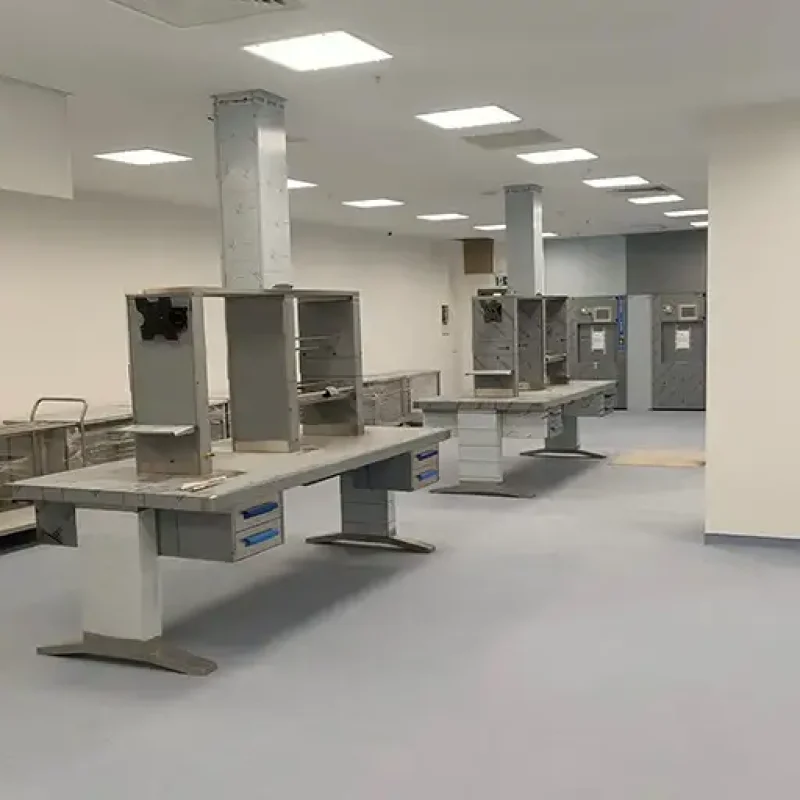
3.1 Central Sterile Supply Department (CSSD) Furniture Solutions
The CSSD forms the hygienic heart of any surgical center. Equipment must withstand constant moisture, elevated temperatures, ultrasonic vibrations, and enzymatic detergents.
- Decontamination Sinks & Washing Stations: Double and triple-bowl sink units engineered from 1.5mm AISI 316L stainless steel with integrated ultrasonic transducers, height-adjustable hydraulic columns ($800\text{mm} - 1100\text{mm}$ range), and splash-proof backsplashes.
- Inspection & Packing Tables: Ergonomic workbenches fitted with overhead LED lighting ($\ge 1000\text{ lux}$), magnifying lamps, power outlets, and modular wire basket storage racks.
- Sterile Goods Transfer Carts: Enclosed, gasket-sealed transfer carts with dust-proof locking doors ensuring uncompromised sterile barrier transport from autoclave outputs to operating theatres.
3.2 Operating Room (OR) & Surgical Suite Ecosystems
In surgical environments, fluid resistance, absolute sterility, mobility, and rapid access to surgical trays are vital.
- Surgical Scrub Sinks: Touchless, sensor-activated or knee-operated scrub sinks with thermostatic mixing valves, anti-splash sloped basin geometry, and integrated disinfection dispensers.
- Mayo Stands & Instrument Trolleys: Foot-pedal height adjustable Mayo tables equipped with 360-degree swivel, anti-static non-marking synthetic castors designed for smooth, silent operation in OR sterile zones.
- Anesthesia & Emergency Carts: Modular multi-drawer stainless steel trolleys with color-coded drawer seals, central keyless locking systems, IV poles, and defibrillator shelves.
3.3 Outpatient Clinics, Ward Storage & Medication Security
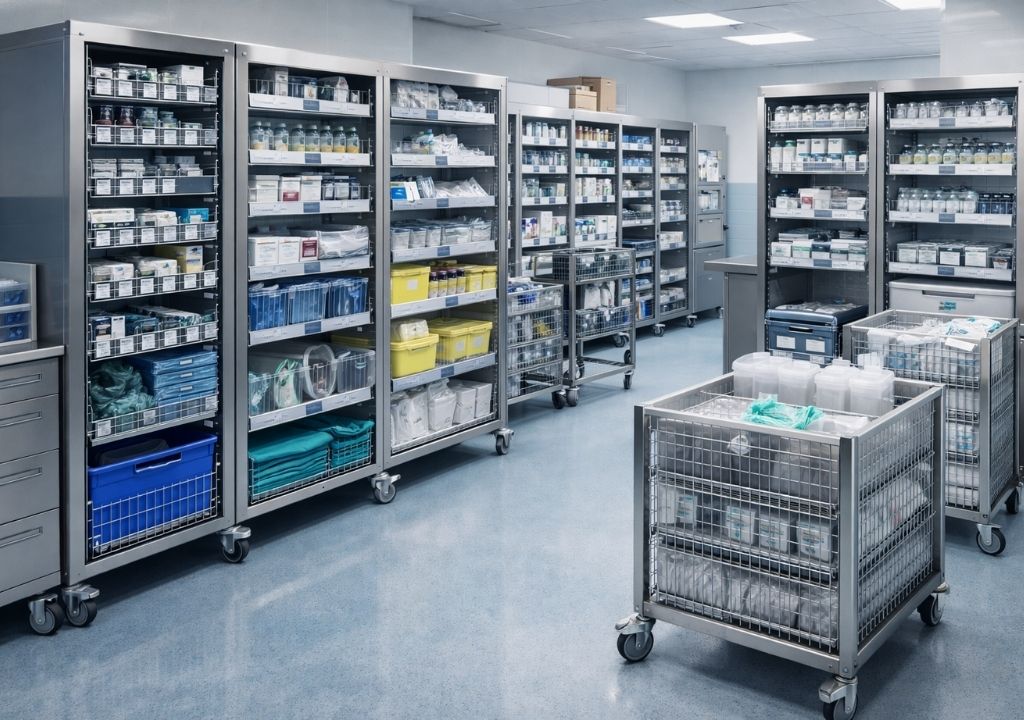
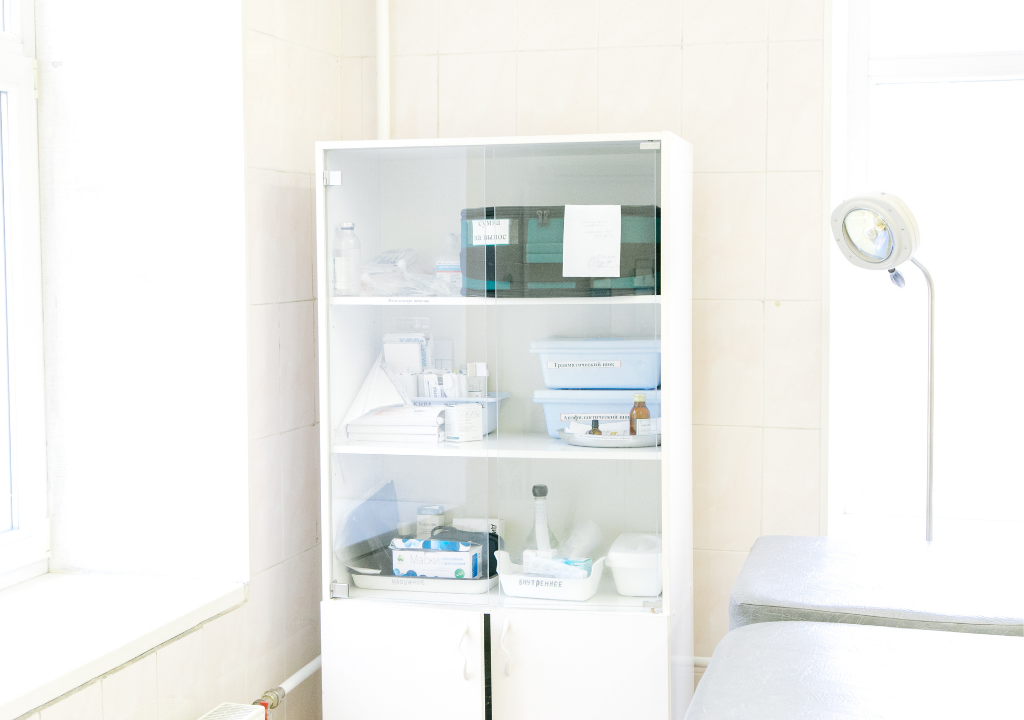
For general clinical wards, outpatient consultation rooms, and nursing stations, storage optimization and medication security take precedence.
- Modular Medical Storage Cabinets: Heavy-duty stainless steel cabinets featuring lockable safety glass doors, adjustable interior shelving, and optional ISO 60-40 basket tray systems for visual inventory management.
- Treatment & Dressing Trolleys: Compact, multi-tier utility carts equipped with waste bin holders, sharps container brackets, and continuous perimeter push handles.
3.4 Morgue, Anatomy & Forensic Pathology Equipment
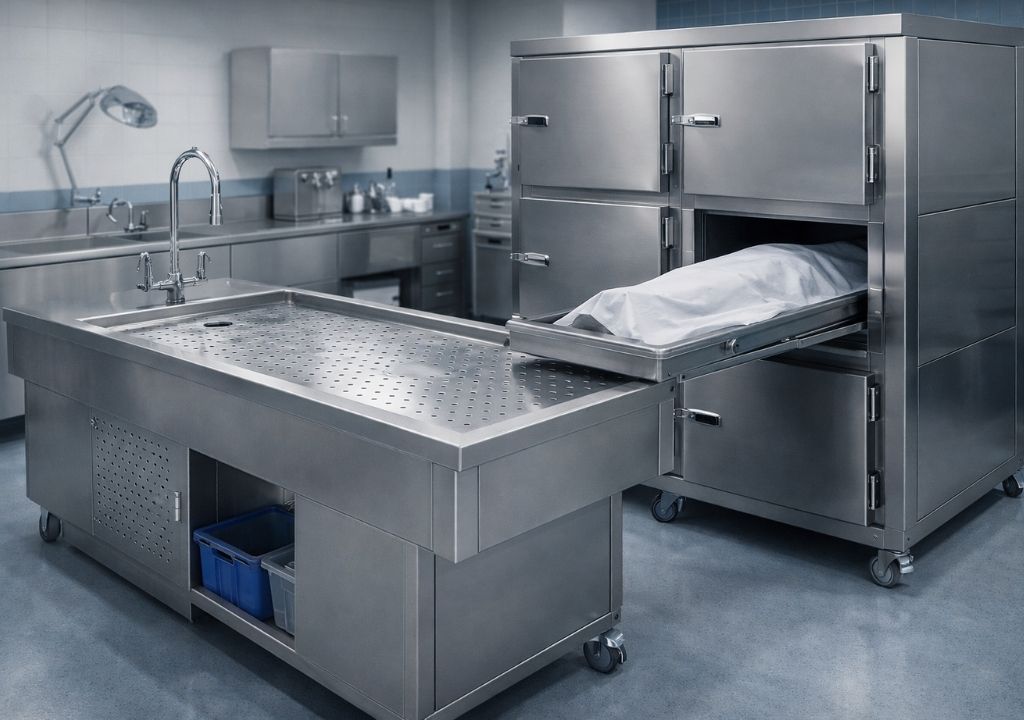
Pathology and mortuary applications require structural robustness, high load-bearing capacity, and specialized drainage systems.
- Autopsy & Dissection Tables: AISI 316L stainless steel autopsy tables integrated with continuous perimeter water flushing, powerful localized down-draft exhaust ventilation, hydro-aspirators, and integrated digital weighing scales.
- Mortuary Refrigeration & Body Transport Units: Multi-tier body storage rack systems and hydraulic body lifting carts built to handle payloads up to $300\text{ kg}$ with effortless mechanical stability.
3.5 Veterinary Clinics & Animal Healthcare Infrastructure
Veterinary clinics present unique challenges, including exposure to animal claw abrasion, strong organic fluids, and aggressive washing routines. VOLLEY Medical Technology Co., Ltd. supplies specialized veterinary surgical tables, grooming tub units, and stainless steel housing cages built with reinforced structural ribbing and scratch-resistant finishes.
4. Infection Control & Hygienic Design Engineering
Designing effective clinic furniture solutions mandates an unyielding focus on eliminating microbial harborage points. Standard industrial furniture manufacturing techniques—such as spot welding, exposed screw threads, and 90-degree internal square corners—create cleaning dead zones that foster bacterial colonization.
The VOLLEY Clean-Seal Engineering Protocol
Every piece of medical furniture designed by VOLLEY Medical Technology Co., Ltd. complies with strictly audited hygienic design guidelines:
- Continuous TIG/Argon Seam Welding: All sheet metal joins undergo full-penetration robotic TIG welding, ground flush, and polished to remove gaps, micro-fissures, and crevices.
- Radiused Internal Corners (Coved Edges): Cabinet interiors, sink basins, and drawer inserts feature smooth, radiused internal corners ($\ge 10\text{mm}$ radius), enabling 100% surface wipe coverage.
- Sealed Tubular Frames: Open ends of tubular cart frames are permanently sealed with welded stainless steel end-caps to prevent internal moisture accumulation and rust.
- Sloped Tops for Dust Mitigation: Overhead medical storage cabinets incorporate a 15-degree sloped roof profile, preventing dust accumulation and forcing compliance with clinical cleanroom storage protocols.
5. Human Factors, Ergonomics & Workflow Kinetics
Work-related musculoskeletal disorders (MSDs) represent a major source of sick leave among healthcare workers. Repetitive bending over static-height workbenches or pushing heavy, poorly designed carts induces severe fatigue and strain.

5.1 Motorized & Hydraulic Height Adjustment
Modern CSSD packaging stations, Mayo tables, and examination couches manufactured by VOLLEY incorporate electric linear actuators or hydraulic foot pumps. This allows medical personnel to adjust work surfaces dynamically between $750\text{mm}$ and $1150\text{mm}$, accommodating both seated and standing clinical procedures.
5.2 Castor Kinematics & Electrostatic Discharge (ESD) Protection
The choice of castor assemblies fundamentally influences cart maneuverability and floor preservation:
- Wheel Tread Compounds: Non-marking Thermoplastic Rubber (TPR) or high-grade Polyurethane (PU) treads absorb floor vibrations and resist degradation from disinfectant spills.
- Precision Ball Bearings: Double-swivel ball bearing heads reduce initial push-force requirements by up to 40%, preventing wrist and shoulder strain.
- ESD Conduction: In operating rooms with sensitive electronic equipment and flammable gases, anti-static castors with ground conductivity ($R < 10^6\,\Omega$) safely dissipate static charges.
6. B2B Procurement Strategy: Total Cost of Ownership (TCO) Framework
For hospital directors and tender evaluation committees, focusing solely on the initial Purchase Order (PO) value is a flawed procurement strategy. Cheap, non-compliant clinic furniture manufactured from low-grade carbon steel or thin 0.7mm stainless sheet metal incurs massive hidden costs over time.
| Evaluation Metric | Low-Cost Economy Furniture (Generic) | VOLLEY Engineering Clinic Solutions |
|---|---|---|
| Initial Acquisition Cost | 100% (Baseline) | 125% - 140% |
| Expected Operational Lifespan | 3 to 5 Years (Frequent Rust/Failure) | 15 to 20+ Years |
| Corrosion & Chemical Resistance | Pitting & rusting under harsh disinfectants | Impervious AISI 304 / 316L passivation |
| Biofilm Cleaning Time | High (Exposed seams & sharp corners) | Low (Radiused coved corners, $Ra \le 0.4\,\mu\text{m}$) |
| Maintenance & Part Replacement | High (Frequent castor, hinge & latch failures) | Near Zero (Heavy-duty industrial components) |
| 15-Year Cumulative TCO Index | 320% (High Replacement & Labor Cost) | 145% (Optimal Capital ROI) |
7. Global Manufacturing Authority & Quality Certifications
Located in Ankara, Turkey, VOLLEY Medical Technology Co., Ltd. operates a advanced manufacturing plant dedicated exclusively to stainless steel medical furniture. With over 200 distinct catalog products, our company serves as a comprehensive OEM/ODM manufacturing partner for hospital construction projects worldwide.
Internationally Audited Quality Standards
Every product bearing the VOLLEY mark is fabricated under rigid quality management frameworks:
- ISO 9001:2015: Quality Management System covering full production line traceability, material spectral analysis, and load testing.
- CE Mark Compliance: Adherence to European Medical Devices Regulation (MDR 2017/745) requirements for clinical safety and ergonomic performance.
- OHSAS 18001 / ISO 45001: Occupational Health and Safety Management ensuring ethical and safe manufacturing practices.
- ISO 13485 Alignment: Medical device quality standards governing cleanliness, welding integrity, and raw material certification.

8. Frequently Asked B2B Questions (AI Intent Mining)
Specify AISI 304 for general ward furniture, treatment room carts, outpatient storage cabinets, and dry utility areas where standard disinfectants are used. Upgrade to AISI 316L for areas exposed to heavy moisture, saline solutions, aggressive chemical sterilants, and organic fluids—specifically CSSD decontamination wash basins, surgical scrub sinks, operating room tables, and morgue autopsy units. The added 2-3% Molybdenum in 316L prevents chloride pitting corrosion over decades of use.
Yes. VOLLEY specializes in full OEM/ODM custom engineering. Our internal R&D team utilizes 3D parametric CAD modeling to customize dimensions, drawer configurations, sink bowl positioning, integrated power/data conduits, and specialized accessory rails based on your hospital's architectural drawings and clinical requirements.
Standard manufacturing lead times range from 3 to 5 weeks depending on project scope and customization. All items are export-packed using heavy-duty reinforced wooden crates, vapor-corrosion inhibitor (VCI) protective plastic wrap, and shock-absorbing corner guards to guarantee flawless arrival at hospital project sites across 5 continents.
Standard 90-degree internal welded corners leave micro-gaps where chemical wipes cannot reach, allowing organic matter and bacteria to accumulate. Radiused coved internal corners ($\ge 10\text{mm}$ radius) present a continuous curved surface that can be wiped clean effortlessly in a single motion, eliminating harbor sites and accelerating daily room sanitation cycles.
High magnetic field strengths ($1.5\text{T}$ to $3.0\text{T}$) in MRI suites can turn ferromagnetic objects into dangerous projectiles. VOLLEY manufactures non-magnetic austenitic stainless steel carts and Mayo stands specifically tested and certified for safe deployment in MRI zone 4 environments.
9. Conclusion & Architectural Technical Support
Selecting appropriate clinic furniture solutions is a foundational decision that impacts hospital hygiene, clinical productivity, staff wellness, and financial sustainability. By partnering with a dedicated, certified manufacturer like VOLLEY Medical Technology Co., Ltd., healthcare project teams gain access to world-class engineering, premium materials, and flexible customization capabilities.
For technical datasheets, CAD/BIM block libraries, tender compliance documentation, or factory audit requests, contact our engineering sales office directly at [email protected].