Knowledge & Industry Insights

Medical Furniture & Equipment Blog

Technical insights, product selection guides, and global hospital furniture standards from VOLLEY Medical Technology Co., Ltd.

0%

Global healthcare buyers are entering 2026 with tighter budgets, higher infection-control expectations, and more demanding workflows. Stainless steel medical carts are gaining attention because they combine corrosion resistance, cleanable surfaces, and structural strength in busy clinical environments. A cart moving through an operating room may face disinfectants, saline splashes, repeated impacts, and constant repositioning. Material choice matters.

The World Health Organization’s Global Patient Safety Report 2024 estimates that around one in ten patients experiences harm in healthcare, with more than half of this harm considered preventable. Equipment design cannot solve every safety problem. It can, however, support safer medication handling, clearer organization, and smoother clinical movement. The WHO Global Patient Safety Action Plan 2021–2030 also emphasizes reliable systems, human factors, and risk reduction. These principles are relevant when comparing drawer layouts, wheel performance, locking systems, and cleanability.

Market forecasts provide useful direction, but they are not perfectly consistent. Grand View Research and Fortune Business Insights both identify continued growth in medical equipment and healthcare logistics markets, driven by hospital expansion, outpatient care, and replacement demand. Their estimates differ because product definitions and regional data vary. Buyers should notice that limitation. A low purchase price may hide weak welds, noisy casters, difficult-to-clean corners, or expensive spare parts.

This 2026 guide evaluates Stainless steel medical carts through practical and procurement-focused criteria. It considers load capacity, stainless-steel grade, surface finishing, ergonomic height, mobility, customization, documentation, and after-sales support. Compliance should be verified against the destination market’s requirements, including applicable ISO quality systems and local medical-device rules. The strongest choice is not always the heaviest cart. It is the cart that remains dependable during real clinical work.
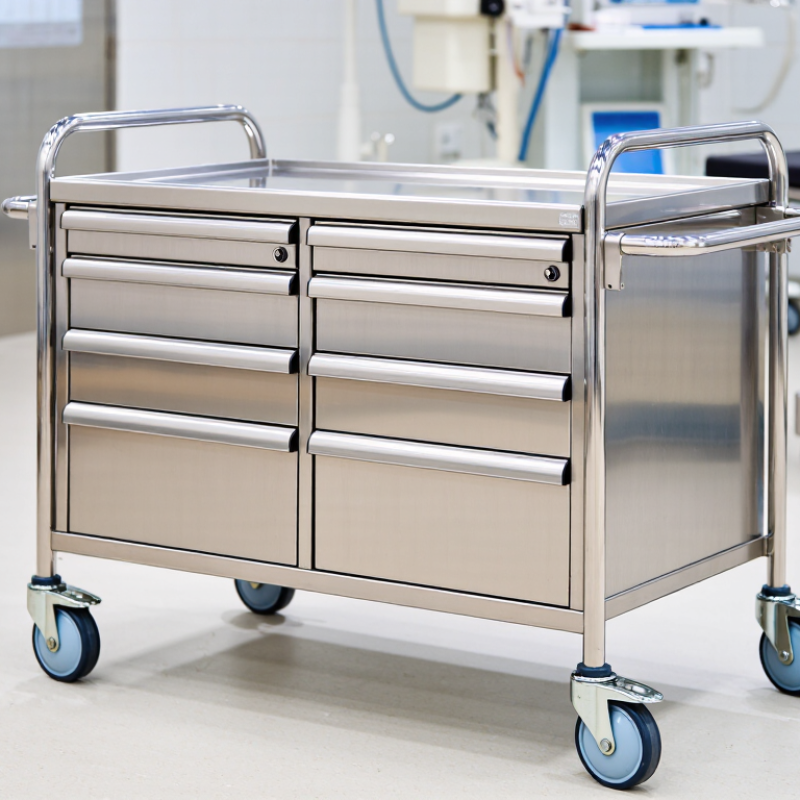
2026 Top Stainless Steel Medical Carts for Global Buyers

What Are Stainless Steel Medical Carts and How Are They Used?

Stainless steel medical carts are mobile workstations designed to store, transport, and organize clinical supplies. Their welded frames resist moisture, frequent cleaning, and daily impacts. Smooth surfaces also reduce hidden dirt around corners. In hospitals, clinics, laboratories, and treatment rooms, staff use these carts for instruments, dressings, containers, and emergency equipment. Locking drawers can support controlled access, while swivel casters help staff move supplies between rooms.

A practical cart should match its workload. Deep drawers suit bulky items, while shallow compartments improve visibility for smaller tools. A raised edge can prevent trays from sliding during movement. Brakes matter on sloped floors. However, stainless steel is not maintenance-free. Harsh chemicals, trapped moisture, or poor cleaning habits may cause staining or surface damage. A shiny finish alone does not prove safe design. Check load capacity, wheel quality, drawer stability, and cleaning instructions before purchase. Small details matter.

Tips:

  • Keep heavy supplies low to improve stability.
  • Label drawers clearly.
  • Clean handles after busy procedures.
  • Inspect casters weekly.
  • Do not overcrowd the top shelf.

A cart can still fail when staff cannot find essential items quickly. avazi

Key Types and Essential Features of Medical Carts

Medical carts are no longer simple storage units. They support medication delivery, emergency response, procedures, and mobile documentation. Common types include medication carts, treatment carts, crash carts, anesthesia carts, and computer workstations. Each serves a different workflow.

Medication carts need divided drawers, tamper-evident access, smooth surfaces, and clear labeling.

The World Health Organization reports that medication errors cost about US$42 billion globally each year. Secure organization matters.

Crash carts require rapid access, sealed supplies, strong casters, and visible checklists. Treatment carts benefit from adjustable trays and space for sterile packs. Computer carts should offer stable writing surfaces, cable protection, and batteries that last through busy shifts.

Material choice also deserves careful judgment. Stainless steel resists repeated cleaning and suits demanding clinical areas, but it can feel heavy and noisy. Aluminum reduces weight, yet may dent more easily. Antimicrobial coatings sound useful, but they should not replace routine disinfection.

That assumption needs restraint. Buyers should review load capacity, wheel performance, drawer locks, electrical safety, and local cleaning protocols. Risk management guidance under ISO 14971 can support a more disciplined evaluation.

In practice, a cart that moves smoothly over thresholds may improve workflow more than a feature-rich model. Small details matter.

How to Evaluate Cart Materials, Design, and Mobility

2026 Top Stainless Steel Medical Carts for Global Buyers

How to Evaluate Cart Materials, Design, and Mobility

In practical equipment evaluations, stainless steel quality is more than a shiny surface. Look for medical-grade 304 stainless steel, or 316 stainless steel for humid and saline environments. Check welded joints closely. Smooth, continuous welds reduce dirt traps and simplify disinfection. A brushed finish can hide scratches, but deep marks may become cleaning problems. Ask for material certificates, surface treatment details, and load-test records. Do not trust appearance alone.

Design affects daily safety and speed. Rounded corners help protect staff during crowded shifts. Drawers should open smoothly, even when fully loaded. Choose layouts that separate clean supplies from used equipment. Adjustable shelves add flexibility, but loose fittings can create vibration and noise. A heavier cart is not automatically better. It may become difficult to move across ramps or narrow corridors. I have seen attractive carts fail because handles were too low for taller users. That detail deserves honest review.

Mobility depends on more than caster size. Large medical casters usually cross thresholds more easily, while high-quality brakes prevent unwanted movement during procedures. Test the cart on tile, vinyl, ramps, and uneven flooring. Measure the turning radius in a real corridor. Push it with one hand after loading it to the intended capacity. Some designs feel stable but steer poorly under weight. Buyers should also confirm replacement parts, cleaning guidance, warranty terms, and local compliance documents before ordering. Specification sheets can be incomplete. Ask difficult questions.

Global Safety Standards and Compliance Requirements

For global buyers, a stainless steel medical cart is not compliant simply because it looks clean. The intended use, electrical features, and destination market determine the required evidence. A basic medication cart may need different documentation from a powered cart carrying monitors or infusion equipment. Ask for a documented risk assessment, material specifications, and traceable production records. ISO 13485 certification can indicate a controlled quality system, but it does not replace local registration or importer responsibilities.

Safety begins at the surface. 304 or 316 stainless steel should be identified clearly, especially where disinfectants, saline, or humid wards create corrosion risks. Welds should be smooth, drawers should resist tipping, and casters should lock without sudden movement. Corners need safe radii. Test it in real corridors. If the cart includes sockets, batteries, or data interfaces, request applicable electrical safety and electromagnetic compatibility reports. IEC 60601 requirements may apply to integrated medical electrical equipment, not automatically to every empty cart.

Buyers should also check cleaning instructions, load limits, spare-part access, and service response times. Labels and manuals may need local languages. Keep serial numbers linked to inspection records. That detail matters during recalls or incident reviews. In practice, teams may approve a polished sample, then discover changed drawer tolerances in production. Factory audits help, although they are not perfect. Independent testing is useful when claims seem vague. Do not accept “global compliance” without named standards, test dates, and market-specific declarations. Requirements vary, and they can change.

How International Buyers Can Select Reliable Suppliers in 2026

In 2026, international buyers need evidence, not polished catalogs, when selecting stainless steel medical cart suppliers. Hospital carts face disinfectants, impacts, moisture, and constant movement. Small details matter. Request the exact stainless-steel grade, weld photographs, load-test results, and corrosion-testing records. Ask whether testing used your hospital’s cleaning chemicals. A cart that survives a showroom inspection may still fail beside a busy treatment area.

The WHO Global Report on Infection Prevention and Control, published in 2022, estimated that 7 in 100 acute-care patients in high-income countries acquire at least one healthcare-associated infection. The estimate rises to 15 in 100 in low- and middle-income countries. This makes cleanability a procurement requirement, not a cosmetic feature. Check sealed joints, rounded corners, removable trays, and drainage around casters. Test the sample yourself. Do not rely only on laboratory photographs.

Reliable suppliers should provide material certificates, batch traceability, inspection records, and replacement-part availability. An ISO 13485-based quality system can show process discipline, but one certificate cannot prove product performance everywhere. Confirm regulatory documents for the destination market separately. Compare packaging strength, delivery history, warranty response, and communication during a small pilot order. No checklist is perfect. Buyers should record failures, revise specifications, and avoid choosing the lowest quotation without calculating maintenance costs.

FAQS

What is a stainless steel medical cart used for?

It stores, transports, and organizes clinical supplies. Staff use it for instruments, dressings, containers, and emergency equipment.

Where are these carts commonly used?

They serve hospitals, clinics, laboratories, and treatment rooms. Their casters help staff move supplies between nearby areas.

How should cart storage match the workload?

Deep drawers hold bulky supplies. Shallow compartments make smaller tools easier to see and reach.

What features improve cart safety during movement?

Raised edges help prevent trays from sliding. Swivel casters support movement, while brakes help on sloped floors.

Does stainless steel require no maintenance?

No. Harsh chemicals, trapped moisture, and poor cleaning can stain or damage the surface.

How can staff keep a cart stable and organized?

Keep heavy supplies low and avoid overcrowding the top shelf. Label drawers clearly and inspect casters weekly.

What evidence should buyers request from suppliers?

Ask for material certificates, weld photographs, load-test results, and corrosion-testing records. Request batch traceability and inspection documents.

How can buyers judge cleanability before purchasing?

Inspect sealed joints, rounded corners, removable trays, and drainage near casters. Test a sample with local cleaning chemicals.

Is one quality certificate enough to prove cart performance?

No. A certificate shows process discipline, but it cannot prove performance in every treatment area.

How can international buyers reduce purchasing mistakes?

Start with a small pilot order. Compare packaging, delivery history, warranty response, replacement parts, and maintenance costs. A checklist can still miss something.

Conclusion

Stainless steel medical carts are mobile equipment platforms designed to support the safe organization, transport, and delivery of medical supplies, instruments, medications, and documentation in healthcare environments. This article reviews major cart types, including treatment, emergency, medication, instrument, and utility carts, while explaining essential features such as adjustable storage, secure drawers, smooth surfaces, ergonomic handles, locking casters, and easy-clean construction. It also highlights how material quality, structural strength, weight capacity, maneuverability, and maintenance requirements affect daily performance.

For global buyers, selecting the right cart requires careful attention to infection-control design, user safety, stability, electrical components, and applicable international standards. The article provides practical guidance for comparing stainless steel grades, weld quality, finishes, mobility systems, customization options, packaging, and after-sales support. It also outlines a supplier evaluation process covering manufacturing capabilities, quality-control procedures, technical documentation, product testing, communication, lead times, and export experience, helping buyers make reliable and cost-effective purchasing decisions in 2026.

Amelia

Amelia

Amelia is a dedicated marketing professional with a profound expertise in the company’s product offerings. With a keen understanding of market dynamics and consumer needs, she plays a pivotal role in crafting compelling narratives that highlight the unique features and advantages of our services.......